

For decades, psychologists have wrestled with a tantalizing question: why are some people happier with their lives than others? The answer, as a groundbreaking new study suggests, may lie in the contours of their personality. Published in the Journal of Personality and Social Psychology, the research presents one of the most robust analyses to date, linking life satisfaction to the Big Five personality traits—and it does so with startling precision.
The study draws on data from over 22,000 participants across three linguistic and cultural groups: Estonian, Russian, and English speakers. It employs a novel methodology that combines self-reports and informant assessments to sidestep biases inherent in single-method approaches. Its conclusion is striking: personality traits, especially neuroticism, extraversion, and conscientiousness, are powerful predictors of how satisfied people are with their lives. Indeed, the correlation between personality and life satisfaction reached an astonishing r = 0.8 in some cases, a figure rarely seen in social science research.
The Architects of Happiness
The Big Five personality traits—openness, conscientiousness, extraversion, agreeableness, and neuroticism—have long been considered the scaffolding of individual differences. Yet their influence on life satisfaction is uneven. Emotional stability (the inverse of neuroticism), extraversion, and conscientiousness showed the strongest positive correlations with life satisfaction, ranging from r = 0.3 to r = 0.5. Traits like agreeableness and openness, often extolled in social and creative contexts, were surprisingly modest in their impact.
At a granular level, the study identifies nuanced personality facets that sway satisfaction scores. Feeling misunderstood, uninspired, indecisive, or envious were associated with lower life satisfaction (correlations as high as r = -0.7). By contrast, traits like self-confidence, resilience under pressure, and a penchant for cooperative problem-solving were tied to higher satisfaction. Such findings offer a glimpse into the psychological alchemy of happiness, which appears rooted not just in broad personality domains but in specific behavioral tendencies.
Insights from Personality Inventory Data
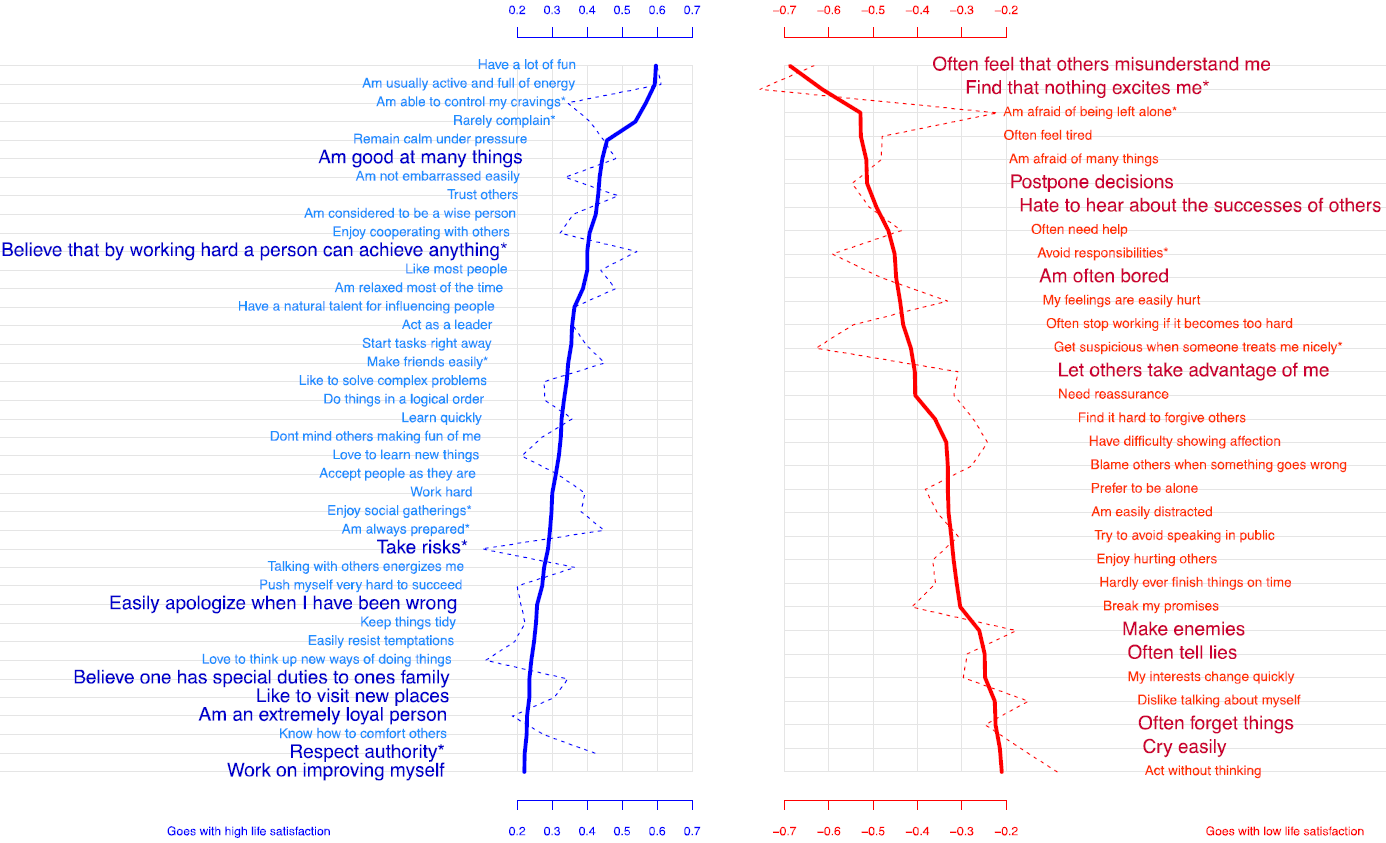
An analysis of personality inventory data further underscores these findings. Among the strongest positive predictors of life satisfaction were behaviors and attitudes such as «having a lot of fun,» «being active and full of energy,» and «remaining calm under pressure.» Individuals who «trust others,» «enjoy cooperating,» and «believe in hard work as a means to success» also scored higher on satisfaction measures. These characteristics align with a sense of social harmony and self-control, which may bolster one’s ability to navigate life’s inevitable setbacks.
Conversely, traits negatively associated with life satisfaction include «often feeling misunderstood,» «finding that nothing excites me,» and «postponing decisions.» Indicators of high neuroticism, such as «my feelings are easily hurt» and «often bored,» also correlate with lower satisfaction. Notably, characteristics like «letting others take advantage of me» and «avoiding responsibilities» highlight a passive or dependent mindset that tends to detract from overall happiness.
This data captures a stark divide: those who embrace optimism, resilience, and proactive problem-solving often experience greater contentment, while traits reflecting indecision, mistrust, or emotional volatility pull life satisfaction scores downward. This duality reinforces the broader conclusion that personality—particularly emotional stability, conscientiousness, and extraversion—is a key driver of well-being.
A Predictable Equilibrium
What makes this study particularly compelling is its longitudinal dimension. Over a ten-year period, individuals’ life satisfaction remained remarkably stable (r = 0.7), closely mirroring their personality profiles. This suggests that while life circumstances—jobs, relationships, health—ebb and flow, an individual’s baseline contentment is deeply anchored in their enduring personality traits. Satisfaction with life’s specific domains—from work to relationships—also reflected these same patterns, further reinforcing the link.
The researchers also found that specific life events, while impactful in the short term, tend to have only fleeting effects on overall life satisfaction. A promotion at work or a new romantic relationship, for example, may temporarily boost happiness, but the long-term trajectory is determined more by internal dispositions than external rewards. This finding underscores the «set point theory» of happiness, which posits that people’s baseline levels of well-being remain relatively constant over time, barring significant interventions or life changes.
Implications Beyond Psychology
These findings are not merely of academic interest; they hold profound implications for policymakers and employers alike. If personality traits underpin happiness, then interventions aimed at fostering emotional stability, conscientiousness, or extraversion could yield lasting dividends in individual well-being. Schools, for instance, might focus on cultivating resilience and self-efficacy in students. Workplaces could structure roles and incentives to align with employees’ personality profiles, boosting both productivity and satisfaction.
Governments, too, might take note. While economic growth and social policies aimed at reducing inequality are critical, this research suggests that broader societal well-being may also depend on cultivating traits like conscientiousness and emotional resilience. Public health campaigns could, for instance, promote mindfulness programs to enhance emotional stability, or incentivize educational initiatives that teach self-discipline and goal-setting skills, which align with conscientiousness.
Yet the study also underscores the limitations of external interventions. Life satisfaction is, in large part, a product of relatively stable personality traits, suggesting that happiness initiatives may face diminishing returns unless they address these deeper psychological foundations. The findings also challenge the notion that openness and agreeableness, often celebrated in the cultural zeitgeist, are panaceas for well-being. Kindness and creativity, while virtuous, may matter less for happiness than grit and gregariousness.
The Limits of Change
For the chronically dissatisfied, the research may appear dispiriting, implying that some of life’s discontents are hardwired. But the authors caution against fatalism. While personality traits are remarkably stable, they are not immutable. Emerging research in psychotherapeutic and behavioral interventions suggests that targeted efforts can nudge traits over time, potentially altering an individual’s trajectory of satisfaction. Even small changes in neuroticism or conscientiousness, the study hints, could yield outsized gains in happiness.
Moreover, understanding the personality-happiness link offers a more compassionate lens through which to view individual differences in well-being. Recognizing that some people face steeper psychological hurdles to contentment can guide efforts to provide tailored support—whether through therapy, social programs, or workplace accommodations.
A Call to Action
As the authors elegantly conclude, most people’s life satisfaction is shaped by the same enduring factors that shape their personality. Like a melody composed long before the first note is played, happiness often reflects the temperament we bring to life’s stage. For policymakers, psychologists, and those in search of personal contentment, this study serves as both a sobering reminder and a call to action: happiness, it seems, begins from within.
At the same time, the findings invite deeper societal reflection. If personality traits play such a critical role in life satisfaction, should more resources be allocated to early childhood development, where these traits are first shaped? Could schools and workplaces design programs that foster traits linked to happiness, such as conscientiousness and resilience? And might governments measure national progress not just by GDP but by indicators of well-being rooted in personality science?
The study offers no easy answers but provides a compelling framework for addressing these questions, emphasizing that fostering traits like emotional resilience and conscientiousness may be among the most impactful strategies for enhancing well-being. At its core, it reminds us that happiness is not merely a matter of chance or circumstance but a reflection of who we are. Changing that, while difficult, may hold the key to a more satisfied society.