
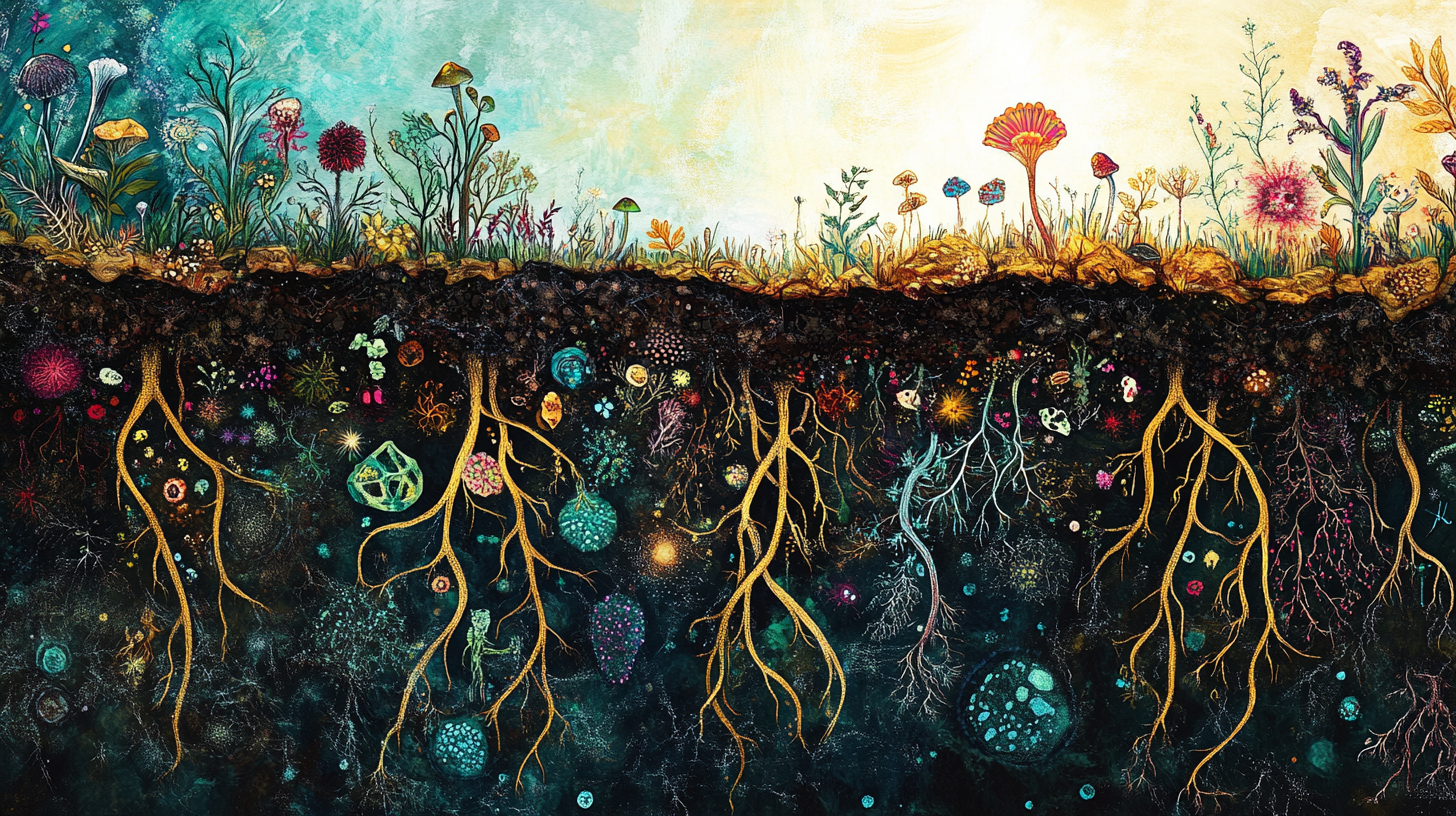
When most people think about soil, they imagine something inert — a brown, dusty backdrop to more interesting forms of life. It’s just dirt, right? Something to be swept off your shoes or shoveled in the garden.
But once you look a little closer, you realize the truth: soil isn’t dead matter. It’s one of the most vibrant, densely populated ecosystems on the planet. In just a single teaspoon of healthy soil, there are more living organisms than there are human beings on Earth.
Welcome to the astonishing, mostly invisible world of soil microbiology.
Beneath the surface, a teeming community of microorganisms is constantly at work. Bacteria, the most numerous of these life forms, quietly perform tasks that human civilization utterly depends on. They break down dead plants and animals, recycle nutrients back into forms that new life can use, and — in some cases — pull nitrogen directly from the air and fix it into the soil, making it available to crops. Without these unseen workers, the fields we depend on for food would quickly become barren.
Fungi form another critical piece of this underground puzzle. When we think of fungi, we tend to picture mushrooms sprouting from forest floors after a rainstorm. But the real action happens underground, in the sprawling networks of mycelium — fine, thread-like structures that weave through the soil, linking plants together. These fungi don’t just coexist with plants; they form deep partnerships. In exchange for sugars produced by photosynthesis, fungi help plants gather water and nutrients that would otherwise be out of reach. Some scientists even describe forests as “superorganisms,” stitched together by these fungal networks — a literal “wood wide web.”
Of course, bacteria and fungi aren’t alone. Protozoa — single-celled creatures often overlooked by casual observers — roam the soil, hunting and devouring bacteria. In doing so, they help control bacterial populations and release nutrients back into the soil in plant-available forms. Then there are nematodes, tiny worm-like creatures that thread their way through soil particles, some of them beneficial predators, others notorious pests. Even stranger residents like archaea, ancient microorganisms distinct from bacteria, contribute by processing nutrients in ways that scientists are still trying to fully understand.
Why should any of this matter to you? Because without this microscopic life, the visible world would collapse. Healthy soil is essential for growing crops, maintaining forests, filtering water, and even stabilizing the climate. Soil microbes play a decisive role in locking away carbon, making soil one of the planet’s largest carbon reservoirs. When soils are healthy, they act like a sponge, absorbing and sequestering carbon that would otherwise contribute to global warming. When soils are degraded — by overfarming, deforestation, or pollution — they can release that stored carbon back into the atmosphere, accelerating climate change.
And soil isn’t just important for farming or forests. In some cases, soil microbes are nature’s cleanup crew. Certain bacteria can metabolize toxic substances like oil, heavy metals, and industrial chemicals, effectively «eating» pollutants and turning them into harmless byproducts. Researchers are now exploring how these natural processes can be harnessed for large-scale environmental remediation.
Despite its importance, the world of soil microbiology remains a vast frontier. Scientists are constantly discovering new species, new interactions, and new ecological principles hidden just beneath our feet. To study these invisible communities, researchers collect soil samples and use powerful microscopes to look directly at the life within. More recently, the rise of genetic sequencing technologies has allowed scientists to read the DNA of entire soil ecosystems, unlocking a deeper understanding of what’s happening in this subterranean universe without needing to culture each organism individually.
Once you start thinking about soil this way — as a living, breathing fabric woven from countless microscopic threads — the world above it starts to look different too. Every forest, every farm, every grassy field depends on this hidden layer of life. Civilizations rise and fall depending on the fertility of their soils. Ecosystems flourish or collapse based on the vitality of the microbes underground.
The Architects Below: How Microbes Build and Shape Soil
Once you start seeing soil as alive, a new question emerges: if microbes are so important, what exactly are they doing down there all the time?
The short answer is: they are constantly building, breaking, gluing, and transforming soil. Not just chemically, but physically — shaping the very texture, fertility, and resilience of the ground itself.
At the simplest level, microbes act like tiny, tireless builders. As they move, grow, and metabolize, they produce sticky substances that bind tiny mineral particles together. Imagine grains of sand, silt, and clay getting glued into larger clusters, called aggregates. These aggregates are crucial: they create the spaces (pores) that hold air and water — two of the most essential ingredients for healthy plant life.
Without these microbial “glues,” soil can become compacted, hard, and lifeless, like bricks. With them, soil stays loose, airy, and fertile, allowing roots to grow deep and water to infiltrate rather than running off. In other words, microbes build the scaffolding that plants depend on.
At the same time, microbes are also nature’s recyclers. Every time a leaf falls, a root dies, or an animal passes away, it’s the microbial community that swings into action. Different species specialize in breaking down different types of materials — some attack the tough lignin in wood, others the simple sugars in fresh leaves. Their decomposition work not only prevents the world from being buried under mountains of dead material; it releases a steady flow of nutrients like nitrogen, phosphorus, and potassium back into the soil.
This recycling process turns dead organic matter into a rich, dark substance called humus. Humus is like a giant battery for soil: it stores nutrients and slowly releases them over time. It also helps soil retain moisture, making land more drought-resistant — an especially important property as climate change intensifies.
But microbes aren’t just passively responding to the environment. They actively shape it. Some bacteria form symbiotic relationships with plants — most famously the rhizobia bacteria, which live in little nodules on the roots of legumes like beans and peas. In exchange for sugars from the plant, these bacteria pull nitrogen from the air and turn it into fertilizer. It’s one of the rare natural processes that can create new, plant-usable nutrients from scratch, without relying on decomposing material.
Other microbes wage war underground. Certain fungi and bacteria can suppress plant diseases by outcompeting or even attacking harmful pathogens in the soil. Healthy microbial communities act like an invisible immune system for ecosystems, preventing outbreaks before they start.
When you zoom out, you realize the soil microbiome — all the microbes together — behaves a lot like a complex, self-regulating society. Different players perform different jobs. There are engineers building structure, recyclers breaking down waste, chemists unlocking hidden resources, doctors defending against threats, and traders exchanging goods with plant partners.
When soils lose their microbial richness — through heavy chemical farming, excessive tillage, pollution, or erosion — this underground society breaks down. The soil becomes physically degraded, chemically depleted, and biologically fragile. That’s why modern movements like regenerative agriculture focus so heavily on rebuilding soil life, not just adding fertilizers. Rebuilding the microbial web rebuilds everything else.
Once again, the lesson is simple but profound: the life beneath our feet is not random or secondary. It’s a careful, ancient engineering project — millions of years old — that makes the Earth habitable. Without it, we have no crops, no forests, no grasslands, no civilization.
Soil microbes aren’t just surviving underground. They are architecting the very world we live on.
Awesome, let’s roll forward.
Now that you know how soil microbes build and sustain soil, it’s time to dive into the next essential idea:
Broken Underground: How Humans Are Disrupting the Microbial Web of Life
For millions of years, the life underground operated with a kind of quiet stability. Forests rose and fell. Rivers changed course. Animals grazed, died, and decomposed. Through it all, the soil microbial world adapted and thrived, cycling nutrients, storing carbon, and rebuilding itself after every disturbance.
But in the last few thousand years — and especially in the last hundred — humans have begun disrupting these ancient systems at a speed and scale that soil life has never faced before.
It starts with plowing. Traditional farming practices involve turning over the soil to kill weeds, prepare seed beds, and mix in residues. But plowing, while useful in the short term, slices through the delicate networks that microbes — especially fungi — build underground. Think of plowing as running a giant blade through a coral reef: the structure collapses, and many of the organisms depending on it either die or scatter. Every time soil is tilled, it loses organic matter, exposes microbes to air (causing them to burn through carbon stores), and leaves the ground more vulnerable to erosion.
Then comes chemical agriculture. Synthetic fertilizers deliver nitrogen, phosphorus, and potassium directly to plants, bypassing many of the natural nutrient cycles. At first glance, this looks like a miracle: faster growth, bigger yields. But there’s a hidden cost. When plants are force-fed nutrients, they reduce their reliance on microbial partners, and the microbial community withers from disuse. It’s like feeding someone through an IV instead of letting them eat — the digestive system atrophies. Over time, soils become dependent on artificial inputs, losing their natural fertility.
Pesticides and herbicides bring another layer of disruption. They don’t just target pests and weeds — they can also damage non-target microbial populations, knocking out beneficial bacteria and fungi that plants quietly depend on. The soil becomes quieter, emptier, more sterile.
Urbanization adds yet another wound. When we pave over land for cities, roads, and parking lots, we cut off soil from air, water, and life. Microbial communities suffocate under asphalt. Even in suburban lawns, where a thin layer of soil remains, compaction, chemical treatments, and monocultures of turfgrass mean microbial diversity plummets.
Deforestation and overgrazing strip away the protective cover that shields soils from sun, wind, and rain. Without plants to feed them sugars through roots, soil microbes starve. Without roots to hold it together, the soil itself washes away in floods or blows away in dust storms. (The Dust Bowl of the 1930s wasn’t just bad luck — it was an ecological collapse driven by reckless land practices.)
All these disruptions come with cascading consequences. Soils lose their structure. Water runs off rather than soaking in. Crops need ever more fertilizer to maintain yields. Rivers and lakes downstream clog with chemical runoff. Carbon once locked safely underground releases into the atmosphere, accelerating climate change. It becomes a vicious cycle: degraded soils fuel environmental instability, and environmental instability makes soils even harder to heal.
And yet, this isn’t a hopeless story.
Because just as soil life can be destroyed, it can also be rebuilt. New approaches — sometimes called regenerative agriculture, conservation farming, or rewilding — focus on restoring microbial health. Techniques like no-till farming, cover cropping, compost application, rotational grazing, and agroforestry are all ways to nurse the underground community back to strength. Even small changes — like planting diverse species instead of monocultures — can jump-start microbial recovery.
Healing soil isn’t just about growing more food. It’s about reactivating the ancient life systems that make our planet resilient, breathable, and abundant.
If humans can learn to partner with the microbial world again — to farm with it, not against it — we won’t just avoid collapse.
We might unlock a new era of abundance, grounded in respect for the tiny, invisible builders that made life on land possible in the first place.
Soil as a Climate Machine: How Microbes Could Save the Planet
When people talk about fighting climate change, the usual images come to mind: solar panels, electric cars, giant wind farms spinning against a blue sky.
But what if one of the most powerful solutions was hidden underground, in a world measured not in meters or miles — but in microns? What if the smallest organisms on Earth held one of the biggest keys to our future?
It turns out, soil microbes are not just passive players in the global carbon cycle. They are active managers of it. And understanding them could change everything about how we approach climate resilience.
At the heart of it is a simple, profound reality:
Plants pull carbon from the air during photosynthesis, turning sunlight, water, and CO₂ into sugars.
Plants feed a large portion of those sugars into the soil, through their roots. They aren’t just nourishing themselves; they’re deliberately feeding the microbial world below. In exchange, microbes help plants access nutrients, fend off diseases, and grow stronger.
When microbes consume these sugars, some of the carbon cycles back into the atmosphere. But a significant portion gets locked away — in microbial bodies, in sticky substances that glue soil particles together, and in complex organic molecules like humus. Some of this carbon can stay in the ground for decades, centuries, even millennia.
This natural process is called carbon sequestration.
And here’s the staggering part:
The world’s soils currently hold about 2 to 3 times more carbon than the atmosphere.
If we can increase soil carbon by even a small percentage, we could dramatically offset global emissions.
And microbes are the workforce that makes it happen.
The emerging idea is often called «soil carbon farming» or «regenerative carbon cycling.» It’s not about inventing new technologies; it’s about restoring and amplifying ancient biological systems. Practices like planting cover crops, minimizing soil disturbance, keeping living roots in the ground year-round, and integrating livestock carefully into grazing systems all aim to boost microbial activity — and therefore carbon capture.
But there’s a catch:
Microbial life is sensitive. It can be a powerful carbon sink — or, if the soil is disturbed, it can become a carbon source. Poor land management (over-tilling, deforestation, monoculture farming) can flip the balance, causing soils to belch carbon instead of storing it.
This makes soil microbiology both a great opportunity and a great responsibility.
We can’t just hope microbes will fix things if we keep mistreating the land.
We have to actively design landscapes that cooperate with microbial life, giving them the conditions they need to flourish and do their ancient, invisible work.
In the best case, soil restoration could offer a «triple win»:
- Heal degraded land
- Grow more abundant, resilient food
- Pull significant amounts of carbon out of the atmosphere, buying critical time in the fight against climate change.
It’s not a silver bullet. No one solution is.
But it is one of the few tools that is available right now, that could scale globally, and that builds life rather than just treating symptoms.
There’s something poetic — and maybe redemptive — about the idea that the smallest architects on Earth might help heal the damage caused by the largest ones.
It’s a reminder that real power often hides where we least expect it.
And that the future may depend not just on high technology and policy summits, but on our willingness to listen — humbly, carefully — to the life humming quietly below our feet.