
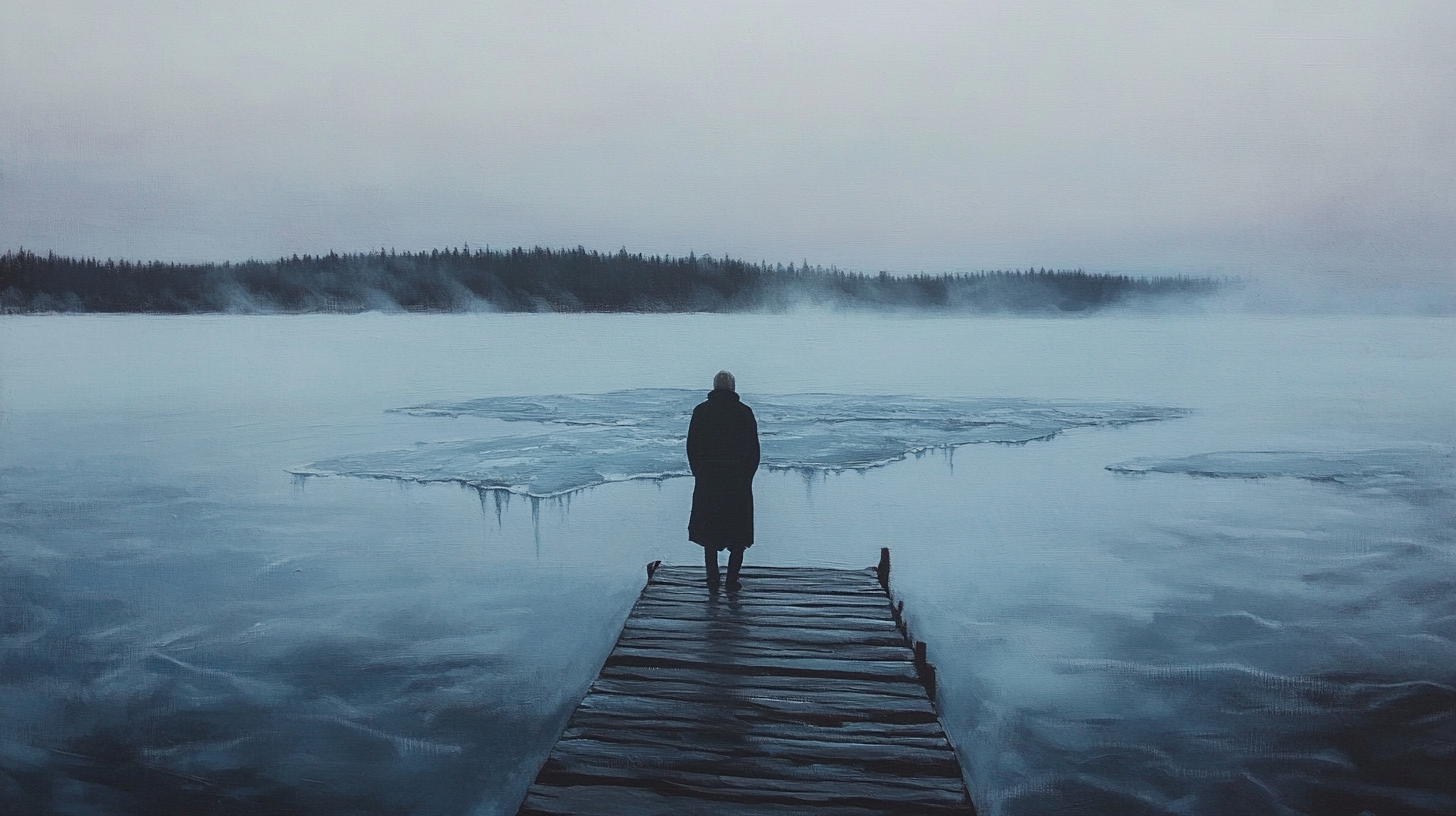
By Karl Ove–esque
Índice de contenidos
Chapter 1 — First Light, 06:47
At six forty‑seven the bedroom was already pale, as though someone had soaked the air in milk overnight. I lay on my back and watched the ceiling resolve itself from darkness to a dull, granular white. Somewhere outside, a gull screeched—too far inland for a gull, I thought—and then the radiator clicked, reminding me of the small lives of pipes and screws beneath the paint. I had slept badly. When I shifted my weight the mattress exhaled in complaint, its springs aging in sympathy with my spine.
I had dreamed of the lake again. Not the summer glare I knew as a child but a flat, matte surface, thick as slate, unbroken except for the faintest ripple tracing the route of an invisible fish. In the dream I stood ankle‑deep at the shoreline, holding a glass jar against my chest. The jar contained a single black feather. I don’t know why, but I remember the feather being heavy, impossibly heavy, as though it were made of iron. When I tried to lower the jar into the water it resisted, the surface tension a skin I couldn’t pierce. I woke just as the glass slipped, feather and all, into the dream‑water. The sound it made was like a church bell struck underwater.
On the bedside table, my phone vibrated once and went still. No message displayed, only the polite suggestion of connection, the way a stranger clears their throat in a cathedral. I ignored it. Instead I stared at the line where the wall met the ceiling, a seam of dusty shadow that reminded me of the gutters along the roof of my childhood home. Rainwater used to overflow there in April, drumming on the metal drainpipe, and I would rush outside in boots two sizes too large, convinced that if I moved quickly enough I could hear the water’s entire history: snowfall in the mountains, trickle through moss, the long slide between stones.
Why do such memories surface on mornings like this? It is as though the mind, unsettled by poor sleep, rattles its shelves and whatever is least secure tumbles into view. I got up, careful not to wake Maria, and padded across the cold floorboards. The apartment smelled faintly of smoke from last night’s fire and of something else—was it lavender?—her perfume clinging to the woollen throw she had wrapped around her shoulders before we argued about nothing.
In the kitchen the first light came through uncurtained windows, blue‑grey, nearly colourless. I filled the kettle, its old tin sides dented like an amateur boxer’s ribs, and set it to boil. Waiting, I leaned against the counter and pressed my thumb into the bruise on a banana until the skin split. The kettle began to rumble; steam coiled upward, blurred the window, rewrote the outside world in condensation.
I thought of Father. At this hour, decades ago, he would be standing in the same pose, in a different kitchen, staring at the back garden while instant coffee dissolved in a mug decorated with a cartoon reindeer. He loved mornings; they made him severe, as though daylight eroded whatever softness he carried through the night. When he drank, the reindeer’s antlers disappeared behind his knuckles.
Why remember him today? Perhaps because the gull’s cry had the same cracked timbre as his voice after late‑night bourbon, or because last night Maria called me stubborn and I heard Father’s chuckle in my own retort. The past is never dormant; it is merely drowsy, waking whenever it smells coffee.
The kettle clicked off. I rinsed the French press, measured six spoonfuls of coarse Ethiopian, and poured the water in slow circles. The grounds bloomed, released a scent that was somehow red and brown at once, a smell I trusted more than any prayer. While the coffee steeped I opened the window. Cold air hit my face; somewhere nearby a bus exhaled at a stop.
Clouds hid the sun but the sky was brightening, a sheet of paper held up against a lamp. I thought of the lake again, the iron feather, the jar. I wondered what would happen if I returned—not in dreams but in life. If I drove north, past the abandoned sawmill, onto the gravel road that bucked beneath the tyres, would the water look any different? Would the house still be there, sagging under moss and memory?
I pushed the plunger, poured two cups. Maria would want hers reheated later, pretending she liked it but leaving half to turn cold on the bedside stool. I carried my mug to the balcony. The street below was empty except for a man dragging a suitcase—no, a violin case—behind him. He walked slowly, as though pacing himself for an argument he could neither win nor avoid.
Steam rose from the cup, disappeared. In that brief column of vapour I saw the years stack themselves: the boy with oversized boots, the teenager sneaking cigarettes by the boathouse, the father I am now, whose children sleep two tram‑stops away with their mother.
The lake is still there, I told myself. Lakes rarely move.
Chapter 2 — Father’s Coffee Cup
The apartment had finished waking by the time I stepped back inside. Pipes sighed, floorboards expanded, the refrigerator emitted a cautious hum as though testing the air. Maria still slept, one arm across the empty space I’d left; her breathing, faint but undeniable, threaded through the rooms like a low violin note.
I rinsed my cup and set it upside‑down in the rack, then opened the highest cupboard—far above eye level, the shelf I rarely touched. Behind a stack of mismatched saucers sat the object I’d been avoiding for months: Father’s coffee cup. Cream‑colored porcelain, chipped at the lip, adorned with a cartoon reindeer caught mid‑prance. The glaze had craze lines now, spider‑thin fractures mapping a territory of unnoticed years.
I lifted it, surprised again by its lightness. In my memory the cup was weighty, anchored by the gravity of early mornings and Father’s taciturn presence. On winter days he would wrap both hands around it as if drawing heat straight into his bones. He drank quickly, impatiently, never letting the surface cool. When he finished he’d slap the cup onto the lino table so hard the reindeer’s antlers seemed to rattle.
The funeral had been small: a priest who mispronounced his middle name, three colleagues from the fisheries office, my sister with a violet scarf he would have mocked. Afterward we boxed his belongings in silence, each object a shard of a man we were relieved and guilty to survive. The cup, absurd and domestic, slipped into my bag almost by accident. Perhaps I thought it a talisman, proof that some fragment of him could be gentle, even whimsical.
I filled the kettle again, this time only half, unwilling to waste water on nostalgia. While it heated I placed the cup on the counter, studying the hairline fissures patterned like frost on windowpanes. I remembered the morning he caught me pouring sugar into his mug—a child’s prank, sugar for the man who despised sweetness. He didn’t shout. He lifted the cup, sniffed, and calmly tipped the coffee down the sink. Then he turned to me, his face unreadable, and said, “A man ought to taste the thing as it is.”
At ten I believed him, took my tea without sugar for years, convinced authenticity required bitterness. Only later did I learn how easily authenticity can mask cruelty, how bitterness can become a refuge for the incurious.
The kettle clicked. I poured a single measure of coffee grounds into Father’s cup—no French press this time—and drizzled water, making a small muddied pool. The smell rose immediately, richer than before, as though the porous porcelain exhaled all the mornings it had previously held. I carried it to the window and sat on the sill, knees tucked to chest, cup balanced between palms the way he used to.
Outside the man with the violin case had vanished. A woman in a lime‑green coat marched past, her phone on speaker, the disembodied voice of someone sobbing from the tiny device. The city turned its gears: bin lorries growled, a cyclist cursed, traffic lights ticked like metronomes.
I tasted the coffee. It felt wrong in my mouth, metallic, as if the cup itself resisted my claim. Perhaps some things don’t survive inheritance; they remain loyal to the hand that wore them smooth. I set it down and pressed my forehead to the glass. The pane was cold, yet it warmed quickly with my skin—an exchange of temperatures, brief and equal.
A memory unfolded: Father standing at the lake’s edge one February afternoon, ice stretching from shore to shore. He held the reindeer cup, steam ghosting sideways in the wind, and told me the ice was never uniform—you must read it like a map, light blue for thickness, gray for danger. “You have to know where to step,” he said, “or you’ll go through.” Then he sipped, squinting at some distant ripple no one else saw.
He spoke of cracks singing at night, of how the lake sounded like whales beneath the earth. I wondered if he heard music in everything or only warnings. I never asked.
The radiator knocked. Somewhere a door slammed. Maria’s footsteps padded toward the kitchen. I turned, cup halfway to the sink.
“You’re up early,” she said, voice rough with sleep.
“Couldn’t stay down.” I gestured with the cup, embarrassed.
She smiled gently. “You found it.”
I nodded. “I’m not sure why.”
She touched the rim with a finger. “Objects know when we’re ready.”
We stood quietly, the three of us—she, myself, and the cup—in subtle congress. Then she took a mug from the shelf and poured half my coffee into it, diluting nostalgia with the present. We drank in silence, not touching, yet close enough I could feel the heat radiate from her shoulder.
As the last sip cooled to bitterness I realised: the lake, the jar, the feather—none of them belonged to dreams alone. They were coordinates. And Father’s cup, chipped and fragile, was the first marker on that map.
Later I would wash it carefully, wrap it in a towel, and place it in the glove compartment of my car. When Maria asked where I was going, I would tell her North. Not for closure, but for cartography.
Chapter 3 — Elverum Road, Kilometre 12
The tyres whispered against wet asphalt, a steady hiss that reminded me of pages turning in a distant room. Dawn had not yet broken; the world beyond the headlights existed only in gradations of charcoal. Maria’s apartment block receded in the rear‑view mirror, its windows unlit, as though the building had folded itself back into sleep the moment I left.
Inside the car it smelled faintly of petrol and the pine‑scented disk hanging from the indicator stalk—an olfactory compromise between forest and machine. Father’s cup rested in the glove compartment, cushioned by a wool scarf. Each curve in the road made porcelain tap softly against plastic, a metronome measuring distance instead of time.
The E6 split at Kårud, the right‑hand branch climbing toward Elverum. I followed it, wipers beating a syncopated rhythm against sporadic drizzle. Billboards advertised tyres, timber, a local politician whose grin failed to mask exhaustion. At kilometre seven the radio crackled to life, unprompted, catching the end of a weather bulletin: “…snow expected above four hundred metres, winds backing north‑north‑east.” Then only static. I switched it off.
What compelled me to start the journey without telling anyone? Even the children, whom I would normally text before a trip, remained unnotified. Perhaps secrecy lent the drive a sharper edge, like walking a familiar corridor in darkness—you learn its true architecture through your shins.
At kilometre twelve a blue sign announced a picnic lay‑by bordered by young birches bent double from last week’s storm. I indicated, slowed, and rolled onto gravel. The engine ticked, cooling. Overhead the sky lightened to pewter; dawn’s hesitant rehearsal.
I stepped out. Wind laced with rain threaded its fingers through my hair. Beyond the guardrail the forest sloped down toward a marshy hollow, the ground bruised by stagnant meltwater. A thin mist hovered, half‑hearted, as if uncertain whether to rise or sink back into the soil.
I opened the passenger door and retrieved the cup. The reindeer seemed almost merry in the half‑light, oblivious to the chill. I walked to the guardrail and set the cup on its flat top. Behind me the hazard lights pulsed—orange, off, orange—silent semaphore to an unseen audience.
Down in the hollow, water pooled around a fallen spruce whose roots jutted skyward like fossilised antlers. The image struck me: antlers mirrored by the cartoon antlers on the cup. A private rhyme, accidental yet insistent.
I remembered a winter when Father drove this same road. The car skidded on black ice near kilometre twelve—my mother told the story for years—spinning twice before stopping unscathed. Father, she said, stepped out, vomited quietly, then got back in and drove on. He never mentioned the incident; his silence became part of the narrative, proof of either courage or shame.
A truck roared past, high‑beamed and impatient. Its slipstream rattled the cup; I steadied it with numb fingers. Why bring it out here? I wasn’t sure. A test, perhaps: would the porcelain remember the place where Father nearly died? Would it vibrate, resonate, crack open and reveal some secret sediment of fear?
Nothing happened. The cup sat mute, collecting drizzle.
I lifted it, poured the thin accumulation onto the gravel, and returned it to the glove compartment. As I closed the door a movement caught my eye: a figure at the edge of the lay‑by, thumb extended in the universal plea of hitchhikers. He was young, twenty at most, hair plastered to his forehead, a rucksack dark with rain.
“North?” he called, voice snagging on the wind.
I hesitated. Father disliked strangers in his car; he claimed they unsettled the equilibrium of enclosed space. Yet the boy’s eyes held a quiet desperation I recognised from my own reflection that morning.
“Yes,” I said, opening the passenger door.
He climbed in, hugging the rucksack. Water dripped onto the mat.
“Thank you. I missed the early bus.” His Norwegian carried a trace of something southern—Danish, perhaps. “I’m Olav.”
I gave my name, started the engine. Back on the road the silence expanded, dense but not uncomfortable. After a few kilometres he asked where I was headed.
“Home,” I said, surprised at the word. “A village by a lake.”
He nodded as if lakes were adequate destinations. “I’m going to the barracks at Terningmoen. Conscription.”
I glanced sideways. “You don’t look thrilled.”
He smiled without humour. “Thrill isn’t required.” He turned to the window, watched the trees blur. “My father was career military. Said this would make a man of me.”
The sentence hung between us like breath on glass. I thought of Father teaching me to read ice, calling me ‘soft’ when I hesitated. I asked Olav if he believed his father.
“I don’t know yet.” He shrugged. “Do you believe yours?”
I didn’t answer. Ahead, the road cut through bedrock, walls of blasted granite weeping with thaw. Somewhere beyond that rock lay the lake, still hours away, but I sensed its pull, a lodestone under the landscape.
“Sometimes,” I said finally. “And sometimes belief is another form of obedience.”
He considered this, then closed his eyes. Within minutes his breathing slowed; exhaustion claimed him. I kept the car steady, mindful of each curve. The cup rattled softly with every bump, as though marking the kilometres, counting down to an arrival neither of us could fully imagine.
Outside, the first flakes of wet snow began to fall, streaking sideways across the headlights—bright insects against the dark. They melted on the windscreen, erased themselves, like words whispered into running water.
Kilometre eighteen. Nineteen. Twenty. The road stretched ahead, a ribbon unspooling toward the unfinished map of memory.
Chapter 4 — Snowmelt in the Drainpipe
Olav stirred awake just south of Rena, mumbling a slurred apology for dreaming in uniform. The sun, faint and wintry, had finally climbed above the spruce tops, bleaching colour from everything it touched. We shared lukewarm coffee from a thermos—Father’s cup remained shut away, a silent passenger—and then I left him at the barracks gate, where a handwritten sign promised MUSTER 11:00. He thanked me with a handshake too practiced for his age, then turned and disappeared into a squad of recruits, all of them identical beneath oversized berets.
The road that led farther north narrowed to a single lane, its verges heaped with sooty snow. Other cars vanished; only the occasional timber lorry barreled past, shaking the Corolla in its wake. I killed the radio. Without voices the cabin filled with a different sound: water hissed beneath the tyres, coursing along hidden culverts, the first proper thaw.
By mid‑afternoon the lake valley opened ahead, a white eye half‑closed by reed beds and the long shadow of the western ridge. I parked outside the old boathouse rather than risk the unploughed track to the house, slinging my backpack and Father’s cup into a battered tote. The air smelled of thawing peat—earth remembering it was earth again.
I walked the final hundred metres. Birch branches, sharp as charcoal lines, scratched at a sky the colour of spoiled milk. The house emerged exactly as I had left it two winters ago: clapboards blistered, the porch sagging as though too tired for posture. A glacier of snow clung to the north wall, but along the south side icicles fell in slow succession, each one shattering like delicate glass on the flagstones.
The key—rusted but loyal—turned once, then jammed. I jostled the handle, shoulder against the door, and a puff of stale air greeted me, heavy with mouse droppings and cold ash. Inside, silence arranged itself in corners, thick and dusty. Yet under that quiet another sound threaded its way: a patient dripping from the eaves, water running through the old zinc drainpipe Father and I had installed the summer I turned twelve.
I set the tote on the floorboards, removed the cup, and listened. Drip, hollow glide, metallic thunk. The cadence was both precise and careless, like a drummer warming before a concert. Each thunk echoed up the downspout, vibrated against the clapboards, and faded into the crawlspace. In childhood this had been the song of spring—proof that the lake ice would soon darken, soften, surrender.
I followed the sound to the back porch. The drainpipe, bent from freeze‑heave, spat meltwater onto a patch of gravel speckled with last autumn’s beech nuts. I crouched, touched a finger to the flow, then to my lips: mineral, tinny, unmistakably of this place. Memory arrived not as an image but as temperature—the raw ache of hands plunged into snow while Father barked instructions from the ladder above, cursing the cheap screws he’d bought in town.
I straightened, cup in hand. A reckless impulse tugged: fill it. Let the reindeer drink what the roof relinquished. I held the porcelain beneath the drip. Water struck the bottom, a single bright note, then another. Tiny rings expanded across the glaze. When the cup was a quarter full, I lifted it to eye level. The water looked clouded, laced with flecks of roof grit.
I raised it anyway, sipped. Cold spread across my tongue, startling and intimate. For a moment I tasted cedar smoke, mothballs, and the wax Father rubbed into his boots—an impossible chemistry, no doubt summoned by the brain rather than the mouth. I swallowed. The water left no aftertaste, only a quick clarity, as though I’d rinsed something murky from my thoughts.
Snow shifted on the roof; a clump slid, crashed beside the porch in a muffled roar. I stepped back, heart rattling. The cup sloshed. A spray of droplets darkened my sleeve.
Inside, evening gathered sooner than expected. I fed the wood‑burner with damp birch logs. Flames caught reluctantly, blue at first, then gold. Shadows trembled across the knot‑holed walls. The drainpipe’s rhythm persisted, a metronome marking the house’s slow thaw.
I unpacked the bedroom: linens stiff from disuse, a wardrobe of dated jackets, Father’s ledger on the bedside table—columns of fishing quotas and pencilled debts. I left the ledger closed. Instead I set the cup on the sill, antlers pointed toward the lake, and watched twilight erase the shoreline until water and sky merged into a single, depthless slate.
In that dim room I heard the lake crack, distant but unmistakable—a low boom, followed by a rippling tremor. The ice announcing its own impermanence. I thought of Olav at his barracks, learning to dismantle rifles. I thought of Maria brewing coffee alone, wondering how far north I had travelled. And I realised the map was unfolding by itself: gull cry, antlers, drainpipe, crack. Each sound a coordinate.
I lay on the mattress in my coat, listening. The drainpipe slowed, the tempo uneven now, as if the roof were deciding what to keep and what to let go. Sleep came cautiously, one layer at a time, through creaks and drips and the distant quaver of settling ice. Just before I surrendered, a final droplet struck the cup, pinging like a tuning fork. The note lingered, a question hanging in the rafters.
Outside, the night froze again, sealing the lake into silence.
Chapter 5 — Letter from Maria
I woke to a metallic light, the kind that seems to arrive from nowhere—sun diffused through ice crystals, sliding beneath the curtains in a thin blade. My throat burned with wood‑smoke and dehydration. In the stillness the house felt larger than memory, as though unoccupied rooms had been breeding in the night.
A rustle at the front porch drew me up. When I opened the door, the wind slapped my face with a smell of raw lake ice. On the top step lay a padded envelope, the paper damp at the corners. No postmark—someone must have driven it out from town and left it without knocking.
Inside, by the stove, I slit the seal with a paring knife. A single folded sheet and a photograph slid onto the table. The handwriting—compact, forward‑leaning—was unmistakably Maria’s.
22 March, 07:15
I dreamt last night that you were under the lake, tapping from beneath the ice. Each tap a syllable I almost understood. When I woke the radiator pipes made the same sound and for a moment I thought the dream had followed me into the room.
You left three days ago. The children think you’re on assignment; I let them believe it. I’ve tried to keep the routine: porridge, school run, evening cartoons I pretend not to enjoy. But the walls feel attentive, as if listening for your footsteps. I’m writing because silence expands too quickly here, like frost fracturing glass.
When you find what you went looking for, will it replace what you left behind? I hope not. Bring something back that fits in your pocket. A stone, a leaf, even lake water in that ridiculous reindeer cup. Proof that distance is porous.
Come home when the ice sings its last song.
—M.
I set the page aside, hands trembling in a way caffeine could not explain. The photograph showed the children at the kitchen table, each holding a spoon like a conductor’s baton. Behind them Maria smiled, eyes rimmed with sleeplessness. I traced the outline of her face. The gloss of the print caught the firelight and for an instant her image flickered, alive.
Windows rattled. Somewhere beneath the floor a mouse scampered across forgotten insulation. I folded the letter, slid it into the breast pocket of my flannel shirt, and poured yesterday’s grounds into the percolator. The water on the stove had not yet boiled; I watched small bubbles form and collapse, the first attempts at language.
As coffee brewed I stepped onto the porch. Overnight the lake surface had whitened, a fresh dusting of snow softening yesterday’s fissures. Yet a long crack meandered from the western inlet toward my shore, a black suture stitching brightness to depth. I imagined Maria hearing that crack from miles away, translating it as absence.
Cup in hand—Father’s cup, rinsed but still smelling of roof‑water—I toasted the horizon, absurd and earnest. Steam rose, met the morning air, vanished. I took a sip and felt the enamel bite my lip where the chip was widest.
The months of silence had begun long before this trip. They began the night I stopped teasing stories from the children at bedtime, the night I answered Maria’s question with a shrug, the night Father died and I told no one how light his body felt when we lifted the coffin. Silence is not merely the absence of sound; it is a sediment that settles unless stirred.
I would stir it. I fetched a mason jar from the pantry, scooped a ladle of fresh snow, and packed it tight. When it melted, it would be lake water distilled through sky. I screwed the lid, placed the jar next to the stove, and watched a single drop form on the inside glass.
The letter pressed against my chest warmed with my body heat, pliant now, as if willing to be rewritten. But I would not answer yet. Letters deserve time, like timber seasoning in a dry loft. Instead I opened Father’s ledger. The first page crackled. In the margin he had written a number I did not recognise—472—and beneath it, a single word in block capitals: KEEP.
Rain began to tap the roof, hesitant, testing the pitch. The lake would glaze, snow would soften, cracks would seal and reopen. I closed the ledger, placed it atop the jar, a paper weight anchoring meltwater. Then I sat at the window with the cup between my palms and listened.
Somewhere under the ice a muffled boom answered the sky’s first raindrop. Call and response—the lake speaking in Father’s voice, the sky in Maria’s. I waited for the next syllable, ready this time to hear it whole.
Chapter 6 — The Library Basement
Rain gave way to a gauzy afternoon mist, the kind that dissolves distance until every tree stands at the same remove. I locked the house and drove the five kilometres into town, passing shuttered kiosks and a petrol station whose lone pump swung idly in the breeze. The library occupied a squat concrete building beside the river; in childhood I thought it resembled a ferry indefinitely moored, its windows forever expecting a shoreline that never shifted.
Inside, the electric heat registers clicked like insects. A fluorescent tube flickered overhead, blinking Morse code no one cared to decode. Behind the desk sat Mrs Strand, her hair the colour of unpolished pewter, reading glasses perched halfway down a nose that had ruled over decades of late‑returns.
She looked up. “Back for the winter, are we?”
“Just a visit.” My voice echoed against linoleum. “I’m looking for fisheries records. Nineteen‑sixties, maybe seventies.”
She adjusted the glasses. “Microfiche. Basement. Machine still works if you coax it.” She retrieved a key attached to a wooden float shaped like a trout—an archivist’s life‑jacket—and handed it across. “Mind the last stair, the tread’s loose.”
The basement smelled of wet newsprint and dormant mould. Shelves bowed under box files, each spine annotated in Mrs Strand’s severe hand. A single desk lamp cast a jaundiced circle onto the microfiche reader; the rest of the room receded into shadow like an unlit stage set.
I fed a reel into the machine, spun forward until the date column read May 1968. Frames blurred past: auction prices for cod, editorial worry over declining perch, terse birth announcements. Then a headline snagged my eye—“Skater Falls Through Ice: Search Abandoned at Dusk.” The accompanying photograph showed rescue volunteers clustered near a pressure ridge. In the background, just beyond depth‑of‑field, stood Father, unmistakable in his waxed canvas coat, gazing toward the hole where the boy had vanished. The caption did not name him, but the tilt of his shoulders—the certain slump—was a signature.
I scrolled further. February 1972: “Permit #472 Revoked—Netting Quota Exceeded.” A table listed vessels and licence numbers. Father’s initials appeared beside LK‑472, ink smudged where a clerk had stamped KEEP ON FILE. The column for fines was blank—replaced instead by a handwritten note: Suspended pending investigation.
I sat back. The ledger number: 472. KEEP. Father’s margin scrawl was not an instruction to me but a bureaucratic relic, copied straight from government paperwork. Yet the absence of a fine puzzled me—violation without consequence.
Microfiche light hummed. Dust motes orbited the bulb like lethargic planets. I loaded another reel: council minutes. April 1972, agenda item seven: “Petition to maintain winter services at south‑lake access road signed by L. Kristoffersen; meeting adjourned pending snowfall update.” No further action.
Kristoffersen—Father. Fighting to keep the road ploughed, the very track I now trudged through snow. A man who feared cracks in ice yet insisted on access. For commerce, or contrition?
A drip sounded in the far corner—condensation from a pipe, echoing like distant footsteps. I switched off the reader; darkness slipped back into the room. On the desk, the reindeer cup, brought almost unconsciously from the car, reflected the lamp’s afterglow. I had filled it with tap‑water before descending and now noticed a fine sheen of dust across the surface.
I blew gently, watched particles swirl then settle on the laminate. Silence here felt curated, as if Mrs Strand arranged it each dawn like fresh flowers.
The cup’s cartoon eyes seemed to challenge me: Taste the thing as it is. I drank. Chlorine and rust, a hint of something metallic the old pipes refused to relinquish. Authenticity, once again, edged with bitterness.
As I stood to leave, a shape emerged at the top of the stairs—Mrs Strand, cardigan wrapped tight.
“Find what you needed?”
“Only questions.” I held up the reel. “Do you mind if I print a copy?”
“The printer’s jammed,” she said. “Take the reel. Nobody else asks for history these days.” She turned, footsteps receding.
Back in the car I wound the microfiche into its plastic sleeve, slid it into the glove compartment beside Father’s cup. The two artefacts—porcelain and celluloid—nested awkwardly, both stamped with the same number that had shadowed the family ledger.
I started the engine. Dusk already blurred the edges of town, streetlights glowing like submerged lamps. As I pulled onto the main road the river flashed silver through bare alders, moving fast with meltwater, shaking flecks of ice from its surface the way a hound sheds rain.
Father had netted that river, exceeded quotas, kept the road cleared so trucks could reach the lake even in deep winter. Had he feared bankruptcy, or was there another debt marked only in silence?
Snowflakes returned, soft and directionless. Headlights carved tunnels through them, each flake a bright incision before it vanished. I thought of the skater lost beneath ice, of permit numbers revoked and fines unlevied, of a man staring at a hole in the lake while dusk cancelled the search. Somewhere between reels, the past had acquired new physics—mass without form, weighing nothing yet altering every trajectory.
Near the turnoff, the Corolla’s tyres caught a rut; the car shuddered, and from the glove box came a muted clink: porcelain against plastic, two records of unfinished stories. I tapped the dashboard—a gesture my father once used to steady himself after long drives—and whispered, as he might have, a promise made to no one: We’ll keep going until daylight tells us what’s underneath.
Chapter 7 — The Colour of Birch Bark
Night folded itself into the rafters while I pored over the ledger, microfiche spool unwound at my elbow like a silver river. The wood‑burner’s glow had dwindled to embers; each inhale drew cold from the floorboards. I read the entry for Permit 472 again—Father’s neat but forceful script: Quota exceeded—see Olafsen; arrangement stands. No signature from Olafsen, no official stamp. Only Father’s assertion that some private agreement shielded the infraction.
I closed the book. Sleep would not come until I gave shape to the questions flickering at the edge of thought. I slipped on boots, grabbed a torch, and stepped outside.
The moon sat low, bruised behind thin cloud. Across the clearing the grove of birches glimmered, trunks ghost‑white against dusk. Birch bark in full moonlight always unnerved me; instead of reflecting light it seemed to generate its own, as though the trees remembered daylight in their cellulose.
I crossed the crust of snow, every step a shatter of ice crystals. At the nearest birch I ran a gloved hand over the bark. It peeled in papery curls, revealing a fresh layer beneath, smooth and tinged with faint cinnamon. The colour reminded me of the skater’s photograph—sepia shadows across white ice.
I broke off a strip, thin as parchment, and held it before the torch beam. Veins and nodules formed a topography of scars: insect borings, winter cracks, healed lightning. I thought of Father teaching me to read bark when I was nine—
Look at the colour, he’d said. New bark is pale because it hasn’t learned the sun yet. Old bark darkens; it remembers burns and droughts. A tree is a ledger written from the outside in.
I had laughed, unsure whether he joked. But now, with his actual ledger heavy in my coat pocket, the metaphor tasted literal.
Further into the grove a stump leaned, felled long ago. I seated myself, switch‑off the torch. Darkness gathered but did not erase the paleness of bark; rather it distilled it into luminous columns. Between trunks, the lake glinted where the ice had bowed under thaw; wind skipped powdery snow across its surface, fine as ash.
I shut my eyes and let sound replace sight: the hush of snow skittering, ice creaking, the hum of blood in my ears. Then, faint yet plangent, another voice: laughter, high and startled. I opened my eyes—only birches stood around me—but the echo persisted, memory or hallucination.
A scene returned in pieces: boys from the village daring one another to race across forming ice. I must have been twelve. The skater—Eirik? Emil?—had ventured furthest. Father’s shout cracked the air just before the ice did. A splash, a scream swallowed by water, frantic scrabbling against glass‑hard edges. Father flat on his belly, sliding a pole toward the hole. My own small hands holding the tail of his coat, anchor to shore.
The rescue failed; the boy slipped under. Dusk closed like a book. Later, lanterns and ropes, Father giving statements to constables. I remember his knuckles raw, blood mixing with lake water.
Had he kept the road ploughed afterward so search parties could return? Or so he could? Permit 472, road petition—attempts to repay a debt quantified only by depth.
Wind lifted, rattling dry catkins overhead. I rose, pocketed the birch strip. Its underside was the colour of old bone, not white yet not brown but something between: the hue of memory once removed.
Back inside, I fed the stove, laid the bark atop the ledger. The heat coaxed resin from its pores, releasing a faint sweetness that overrode smoke. I watched it curl, edges darkening, scriptless and pure.
Father had said bark records from outside in; maybe burning it released the record the way microfiche released his secrets in negative light. I knelt, whispered the skater’s name—Eirik, yes, Eirik Larsen—and let flame take the bark. It flashed, folded, became ash.
In the silence that followed, the house sighed: timber adjusting to temperature, or a man clearing his throat before confession.
Tomorrow I would walk onto the lake. I would find the pressure ridge where Father once lay prone, and listen. But for now the bark’s fragrance lingered, and I let it weave the first dream that night allowed: Father, knees soaked, reaching; my hands on his coat; the colour of birch bark between daylight and dusk, between innocence and its loss.
Chapter 8 — Night Crossing
The moon was not full, but it was bright enough to cast a faint sheen across the lake, a thin rind of pewter that trembled whenever the wind stirred the surface-ice. I stood at the jetty with my hands buried in the pockets of Father’s old coat, the wool still smelling faintly of pipe smoke and the camphor he insisted on each autumn, as if insects might eat their way through memories as easily as through fabric. Behind me the house was unlit; Olav had turned in early, claiming the road had rattled the marrow out of his bones, and Maria was writing in her notebook by the cold stove. I could feel the silence in the rooms even from out here, a hush that seemed to press against the windows like something alive.
I had not meant to come down to the water, not really. I had stepped outside for air, for the space that darkness sometimes offers, and found my feet moving of their own accord. Each crunch of gravel was absurdly loud in the stillness. When I reached the jetty a single board groaned, exactly the way it had when I was ten, running toward Eirik screaming at him to stop rocking the boat. The sound had survived longer than the boy who caused it.
The idea that I might walk onto the ice came suddenly—not as invitation but as obligation. The distance across to the far shore was perhaps five hundred metres, not much by any athletic measure, yet in my childhood it may as well have been Siberia. My father had forbidden us to cross until spring, to wait for the thaw when the boat could be launched safely. Eirik had disobeyed once, stepping out just beyond the reeds, claiming he could feel the ice flex beneath him “like the skin of a drum.” He laughed; I panicked. Two weeks later he was gone. I do not believe the two things were connected, yet cause and effect seldom align neatly in the mind of a child.
Something cracked out on the water—sharp, distinct. I flinched. It was only the ice settling, I told myself, the lake reorganising its fractures, the way bones knit in sleep. Still, it felt as if the sound had opened a narrow passage in the air and through that passage memory poured, slow and viscous. I remembered the ambulance men carrying Eirik’s body up the slope, their boots slipping in the slush, remembered Father’s face so stiff it looked carved. I remembered how, that night, he poured coffee into his cup and never lifted it to his lips, simply sat at the table staring at the dark liquid until dawn.
Now, decades later, the cup lived in my kitchen cupboard in Malmö, chipped at the rim, the green enamel dulled by dishwasher cycles. I used it rarely, yet could never bring myself to throw it away. If I broke it, I sometimes wondered, would the grief finally spill out? Or would it vanish altogether, released from its vessel like smoke?
I stepped off the jetty onto the ice, testing first with the toe of one boot, then placing my weight slowly, like a man approaching a skittish animal. The surface held. A faint snow-film covered the lake, the dim light revealing subtle hairline cracks that radiated beneath me. I began to walk. My breath sounded harsh in the hood of the coat; each exhale rose in a cloud and drifted like a ghost toward the mountains.
After thirty paces the shore behind me already seemed distant, as though I had crossed not metres but years. There was no path, only a pale emptiness stretching ahead, yet my body found a rhythm, knee before knee, heel then toe, a rocking that matched the slow pulse of blood in my throat. With every step the ice issued a complaint—sometimes a dry squeal, other times a sonorous boom that seemed to emerge from the lakebed itself. I discovered that what frightened me most was not the loudest cracks but the near-silent ones, the little spider-fissures I could only hear if I held my breath. They reminded me of tiny lies we tell, hairline deceits that travel in all directions until the surface gives way.
Halfway across I stopped. The wind dropped entirely, and the world became abrupt and static, as if someone had muted the soundtrack of reality. The silence felt heavier than sound. In that suspension I heard, unmistakably, a voice. It was not Eirik’s; it was Father’s, low and resigned, the way he had described the lake during the thaw: “Nothing breaks as loudly as ice.”
I closed my eyes, though the darkness there was no deeper than the night around me. If the ice broke now, I thought, the water would be barely above freezing. I imagined the first swallow of that water into my lungs, the violent seizing of the diaphragm, the mind cleaved from the body in a shock of cold so pure it might resemble grace. I did not desire it; I simply acknowledged the shape of the abyss beneath me, the same way a priest acknowledges the devil in order to dismiss him. I opened my eyes.
To my right, perhaps fifteen metres away, a ribbon of open water had formed—a crack wide enough that the moonlight reached down and struck something metallic: an old beer can, its label long stripped. A ridiculous relic, floating where supposedly nothing should float. I experienced a fleeting, inexplicable tenderness toward the can, as if its useless persistence were proof of some dogged will. Then the moment passed.
I realised I was trembling, partly from cold, partly from the awareness of just how fragile the ice had grown in recent winters. Climate drift, the newspapers said. The old boundaries—of season, of certainty—evaporating. The notion that my childhood precautions might no longer apply frightened me more than any personal danger. If the season itself could no longer be trusted, what, then, of memory? Of the meanings we derived from weather?
I turned for the far shore, no longer curious about what lay beyond. Each step felt heavier, as if the lake had tilted slightly, pulling at my boots. When I reached the reeds on the opposite bank I knelt and pressed a bare hand to the ice, felt the cold climb the bones of my wrist. In the silence I whispered a name—Eirik—and felt nothing mystical, only the dull ache of my knees in the snow. I stood and climbed the low bank into the trees.
The forest here was different than I remembered: a wider spacing between trunks, several stumps where spruce had been harvested. Change everywhere, stripping the world of the coordinates I once trusted. Yet the scent—resin mingled with rot—was unchanged, and it filled me with a calm so abrupt I almost wept. I realised I did not need the forest to remain the same, only the smell, as if memory were inhaled, not seen.
At the ridge a faint yellow glow flickered through the branches: a lantern hung by the door of the small boathouse Father had built in the last year of his life. I thought we had dismantled it after the funeral, yet here it was, roof sagging, door half-open like a mouth mid-confession. I stepped inside. Dust motes swarmed the lantern light; the floorboards were warped, smelling of mould and old diesel.
On a rusted nail near the window hung Father’s second coat—the one he wore when rowing. The sleeves were stiff with salt. Beneath it, leaning against the wall, stood the narrow ledger I had forgotten these last days, its cloth spine flaking, the numbers 472 boldly inked across the cover. My heart lurched. I reached for it but did not open it. I felt, absurdly, that to do so here, in this place where time had folded in on itself, might alter something irreversibly.
Outside the lantern guttered. The wind had returned, rattling the shingles. Through the cracked windowpane I could see the white expanse of the lake and my own footprints leading like a dotted line into darkness. I realised how easily the snow could erase them, and how in the morning no one would know I had ventured across. Memory’s record is as fragile as snow, and just as subject to weather.
I blew out the lantern, tucked the ledger under my arm, and stepped back into the night. The return path would be over land, a long detour through the pines and past the swamp, but the ice had spoken enough for one evening. Above the treetops Orion tilted westward, each star precise, remote, and it occurred to me that the sky is just another kind of frozen lake—an expanse we traverse with our eyes, hearing only distant echoes, feeling the pull of depths we cannot survive. I walked on, the ledger growing heavier in my grip, until the lights of the house began to flicker between the dark trunks ahead.
Chapter 9 — The House by the Weir
Morning arrived flat and colourless, a lid of pewter cloud pressed low against the pines. The kitchen smelled of boiled coffee and damp wool. Maria sat at the table in an oversized cardigan, hair bound back with a green ribbon that once belonged to our mother. She was copying yesterday’s notes into a larger notebook, the nib of her fountain pen scratching like a restless insect. Olav hovered near the stove, frying slices of brown cheese on stale rye and pretending not to read over her shoulder.
I set the ledger on the table with more force than intended. The thud startled them both.
“Found this in the boathouse,” I said. “Father kept it from us—or from himself. Hard to know.”
Maria’s pen paused mid-stroke. A small blue blot blossomed on the page, then spread as if seeking veins. She closed the notebook carefully, dabbing the blot with her sleeve. “You crossed the lake?”
I nodded. “The ice is thinner than we thought.”
Olav whistled under his breath, an unvoiced rebuke. He flipped a slice of cheese; it hissed on the iron and curled like bark.
The ledger’s cloth cover was brittle, the inked 472 half-scabbed away. I opened it. The spine cracked, releasing a musty breath of old carbon paper and pipe tobacco. Inside, Father’s handwriting marched in two neat columns: dates on the left, terse descriptions on the right. Some entries were only numbers—depth measurements, water temperatures—others a single word: Kemisk, Söppell, Defekt. The earliest date was 12 Mai 1967. The last, two weeks before Eirik’s death.
Maria leaned over my shoulder, her ribbon tickling my neck. “He told us he stopped surveying the dam in ’72,” she whispered.
“Father told many stories,” I said, though the bitterness in my voice surprised me.
Halfway down the first page appeared a name I had never seen: Johannes Røyse. Next to it, in Father’s smaller, quicker script: Weir house key, 150 kr, no receipt. The entry re-occurred at irregular intervals—sometimes Røyse alone, sometimes coupled with cryptic notes: pump jammed—night work or north grate iced over.
“I remember that surname,” Olav said quietly. He had abandoned the stove, wiping his hands on a dish towel. “Old man the locals called Weir-keeper. Lived downstream, where the river narrows before the power station. I met him on service once—base patrol after the floods. Dead now, I think.”
An image stirred: a squat timber house tucked into alder trees, its roof sagging under moss, a plank bridge crossing black water. Father would leave before dawn, cycling there with a battered oil lamp strapped to his handlebars. We could see the glow drifting through fog below the garden like an errant star.
Maria closed the ledger. “We should go.”
We. She meant herself and me, but Olav stepped back as if included by default.
“Someone should remain here,” he said. “If the ice breaks, search teams will start at the house. Better they find it occupied.”
I saw relief in his eyes; he disliked errands not written into army orders. I nodded. “Stay, then. Keep the fire alive.”
He saluted without irony and returned to the skillet.
The road to the weir house followed the river, a gravel track bordered by heaps of ploughed snow that bled rust-coloured clay. Slush gurgled under our boots. We walked in silence for the first kilometre, the only sound the eternal mumble of water under ice. A pair of ravens swept overhead, their wings the colour of wet slate.
Maria finally spoke. “Why didn’t Father mention this ledger after Eirik? He documented everything else—doctor visits, milk deliveries, even my piano lessons.”
“Maybe he meant to spare us,” I said. “Or to spare himself.”
“He failed on both counts,” she muttered.
We reached a bend where the river narrowed into a throat of churning foam. A wooden gate hung lopsided across the track. Beyond it, the house crouched beside the weir—two rooms, tarred clapboard, windows papered with yellowed newspaper. One shutter flapped lazily. On the veranda sat a galvanised milk pail filled with thawed rain.
Inside, the air tasted of mould and diesel. An iron stove squatted at the centre like a dormant animal, ash drifts curled in its jaws. The floor dipped toward the river wall; against it stood shelves lined with jam jars, each holding bolts, washers, fuses—the hoard of a solitary mechanic. A photograph of a woman in a floral dress had been thumb-tacked above the workbench. Someone had inked a date beneath: 9 Juli 1966.
Maria trailed her fingers across the jars. “It’s like a mausoleum.”
I wandered toward a hatch recessed into the wall. The lever resisted, then gave. Cold air wafted up, smelling of iron and algae. A narrow ladder descended into darkness. On the rung hung a rubber torch, battery compartment corroded shut. I flicked it out of habit; a weak cone of light answered. Good enough.
“Stay here,” I told Maria.
“Of course not,” she replied, and began down the ladder before I could protest.
The shaft opened onto a concrete gallery, barely wider than our shoulders. Water roared beneath the grates, amplified into a cathedral of hissing. My breath fogged the torch beam; droplets glittered on rebar like sequins. Along the wall ran a row of control boxes—each stencilled NEDERLØP—their padlocks eaten hollow by rust. Father’s handwriting again: numbers scrawled on masking tape labelling each box.
Maria traced one tape with her fingernail. “All within the four-hundreds.”
“Four-seven-two,” I murmured.
At the far end, a steel door bore that exact number, painted in flaking black. The handle turned but did not budge. A padlock—shiny, new—sealed it.
Maria exhaled sharply. “Who locks a room no one visits?”
I scanned the floor. In a puddle lay a ledger almost identical to the one upstairs, though soaked and warped, its pages fused. I nudged it with my boot; water seeped from the spine like blood.
“Help me,” Maria said, pulling at the padlock. It was modern, stainless, incongruent amid the decay.
“Even if we had bolt-cutters, we could be trespassing on utility property,” I said, aware of how feeble it sounded.
She faced me, eyes dark. “Trespass against what? Father’s secrets? Eirik’s silence? You crossed the lake last night—risked your life. Now you hesitate over a padlock?”
Her anger was a match struck inside my chest. I remembered the crack of ice, the image of Father’s unused coffee cup, the years I had spent muting the question of why Eirik ventured onto the water alone. Suddenly the lock felt like a dare.
I took the torch and scanned the floor again. Against the wall leaned an iron rod, probably once a pry bar for sluice gates. I hefted it, surprised by its reassuring heft, and wedged it beneath the padlock shackle. Metal groaned. Maria pressed her shoulder to the bar; we levered as one. With a brittle snap the shackle sheared. The door sagged inward.
A rush of stale air escaped, tinged with something chemical. We stepped inside. The torch beam skated across shelves stacked with wooden crates, each stamped with faded army markings. One lay half-open, revealing coils of detonator cord and sticks of grey putty wrapped in wax paper. Explosives—military surplus, decades old.
Maria’s breath caught. “Why would Father—”
Behind us the door slammed. The torch jerked in my hand; its filament fizzed and died. Complete blackness. Then a voice spoke, calm, thick with dialect neither of us had heard in years.
“I wondered how long it would take you.”
A flare blossomed, casting garish red across the crates. Olav’s face emerged from the glow, features rigid. The flare hissed between his fingers.
“I told you to stay at the house,” I managed, though my throat had dried to paper.
“I did,” he said. “Until the radio crackled. Patrol report: civilians spotted at the old weir.” He shook his head. “I thought, They won’t. But of course you did. Curiosity is our original sin.”
The flare spat sparks. Its sulphur stung my nostrils. Olav stepped closer. “These charges were intended for the dam. Some fool stockpiled them during the Red Scare. Røyse kept watch. Your father kept records—as insurance, perhaps.” He glanced at Maria. “When Eirik drowned, the plan died with him. Father buried it in work, in silence.”
I felt as though the ice beneath me had cracked a second time.
“But why bring explosives home?” Maria asked. “Why document them at all?”
“Because confession requires witness,” Olav said softly, surprising me. “Your father needed someone to look—someday—to see the weight he carried. Documentation is a plea for absolution.”
The flare guttered, its light weakening. In the dimming glow Olav reached into his coat, produced a bundle of plastic ties. “I have orders,” he said. “Contain the site. Detain intruders.”
“Whose orders?” I asked, though I already knew: the same grey bureaucracy that had summoned me here, the same inertia that valued secrecy over grace.
Olav met my eyes. In them I saw fatigue, not malice. He extended his free hand, palm up, offering the ties like a choice.
I looked at Maria. The red light painted her face in bruised colours, but her gaze was steady. Without words we understood the ledger, the ice, the years of silence had all led here—to a room where the past lay volcanically dormant, awaiting a single spark.
I took the ties from Olav and let them fall. They hit the concrete with a hollow rattle.
“No,” I said.
The flare died. Darkness rushed back, vast and total. Somewhere in that black a decision hovered, crackling like ice underfoot, and I sensed that what broke next might not be the padlock, nor even the dam, but the fragile membrane dividing confession from consequence.
I heard Maria exhale, a sound like a match snuffed between fingers. Then, in the darkness, she spoke one word—my name—steady as a hand on the shoulder.
And I understood we had already crossed the real lake. Ahead lay only the unseen depths.
Chapter 10 — The Crack
The darkness that followed the flare’s death was not empty; it throbbed, as if the room itself had a pulse that grew louder the longer we stood in it. Somewhere beneath our boots the river hammered against concrete—an immense, blind animal testing its cage.
No one moved. The scorched smell of the flare hung in the air, mingling with cordite and algae. I heard Maria inhale—sharp, controlled—as if measuring exactly how much breath could be spared. Olav’s leather gloves creaked where he clenched and unclenched his fist. I imagined the three of us as pins suspended in black varnish, each afraid the smallest tremor would set off a chain of hairline fractures.
Then, very quietly, Maria switched on the tiny pen-torch she always carried for reading archival spines. The beam was weak, the batteries dying, but it carved enough space for faces to exist again. Olav’s was pale, almost waxy, the military certainty drained from it now that the script had slipped. I felt a flicker of pity: he had arrived fresh from barracks logic—orders, perimeters, outcomes—and had stumbled instead into the unquantifiable friction of family.
He looked at the plastic ties lying on the floor like discarded serpents. “They’ll send others,” he said. “If we don’t seal the site, they’ll send demolition. Better it happens on our terms.”
“Our terms?” Maria echoed. “Which are what, exactly?” The torch shook slightly; a butterfly of light flitted over crates stamped EXPLOSIV, 1965.
Olav didn’t answer. He turned the flare’s guttered casing in his hand, then tucked it into his coat pocket as if ashamed of its spent violence. The silence thickened again, and with it came the familiar, unwelcome voice of memory—Father’s voice—telling stories at the kitchen table: how rivers could be redirected with dynamite, how ice obeyed its own arithmetic, how sometimes a controlled fracture was the only way to prevent a catastrophic one.
A controlled fracture.
I stepped between Maria and Olav, laid a hand on each of their shoulders. “Listen.” I waited until the roar beneath us—water thrashing through the sluices—aligned with the drum of my heart. “There are two realities down here. One is these crates: potential force, history we didn’t choose. The other is up there—air, daylight, the road that leads away. We decide which matters.”
Olav’s shoulders twitched under my palm. “They’ll still come,” he repeated, but softer now, more a question than a threat.
Maria crouched beside the nearest crate, pried a slat loose, and drew out a grey stick wrapped in waxed paper. In the pen-torch’s glow it looked almost benign, like a mould-speckled candle. She balanced it on her palm, weighing its promise. “What if Father kept these for the same reason he kept the ledger?” she said. “Evidence. Not of an intent to destroy, but of a burden he refused to hand off. Maybe he believed if he guarded them long enough, the future would de-arm itself.”
“Or explode in someone else’s hands,” Olav muttered.
She set the charge back, slid the slat home. “Either way, secrecy has expired. The question is whether we finish burying the past or exhume it.”
The beam caught my eyes; I squinted. “Exhuming means scandal, inquiries, a story none of us controls. Burying means—” I gestured at the crates—“doing something irrevocable.”
The word hovered: irrevocable. Another fracture line traced across the room.
Olav cleared his throat. “If we flooded the gallery—opened the downstream gate—water would cover everything. Clay silt, sediment. Within hours it’d be as unreachable as a black box on the ocean floor.”
“Submerge the evidence,” Maria said, “and the inquiry dies.”
He nodded once. “And the explosives destabilise, harmless under pressure. No detonation without air.”
“But the door upstairs?” I asked.
“I weld it,” Olav replied. “One seam across the latch. On paper, the site stays sealed for ‘structural risk.’ Bureaucracy likes closed doors.”
The plan was brutishly simple, almost childish in its faith that water could absolve. Yet in that moment it felt—if not right—then at least proportionate to the sin: a sin of silence answered by a silence deeper still. And perhaps that was Knausgaardian grace: not redemption, only an honest accounting of imbalance.
Maria handed me the torch. “We decide together. One vote each.”
We stood in a ragged triangle. The torch illuminated hands, not faces, casting shadow-masks high on the damp walls. First Maria raised her index finger—flood. I followed, feeling a tremor run from knuckle to wrist. Olav hesitated longest; then his finger joined ours, closing the triangle. Majority.
He moved toward the sluice wheel, boots echoing on concrete. I caught his arm. “After this,” I said, “you return to barracks, tell them the lock was cut but nothing remained. A caretaker fire, maybe. Papers lost. You saw nothing.”
He met my eyes; something older than duty flickered there. “And you?”
“We empty the boathouse,” Maria answered for me. “Burn Father’s coat, his notes—everything. If we’re erasing, we erase all traces.”
I felt a pang at the coat—pipe-smoke, camphor—but said nothing. The past was always made of fabrics one hesitated to torch.
Olav rotated the wheel. It shuddered, then turned with surprising ease, a grind like teeth. Somewhere below, a gate groaned open. Water surged, slapping the underside of the floor. Spray misted our faces, cold, mineral, alive.
The crates rocked gently, as if relieved. Maria opened the gallery hatch to the shaft; a draught sucked upward, carrying the damp smell of spring thaw.
“Go,” Olav said over the roar. “I’ll weld the door, catch up outside.”
Maria climbed first, torch between her teeth, hair ribbon trailing like a green thought. I followed, each rung slick. Halfway up I glanced down: Olav already masked, sparks arcing firefly-bright against the black aperture of 472. Light enough to mimic stars in the closed universe we were sealing.
Outside, the afternoon remained overcast, but the pale sky seemed newly spacious—as though the river, now swallowing our secret, had broadened the very air. Maria and I walked the track in silence, each step squelching mud that would soon freeze again overnight. In my mind I rehearsed the lie we would tell, smoothing its edges until it fit the tongue like a well-worn prayer.
At the bend she halted, touched my elbow. “Does this make us accomplices?”
“Probably,” I said. “Or penitents.”
“Is there a difference?”
Wind rattled the alder catkins; meltwater trickled into the ditch, its murmur eerily similar to Father’s old radio when it lost a signal. “Penitents admit the wound,” I said. “Accomplices pretend it never happened.”
She considered this, then slipped her arm through mine, like when we were children crossing unsafe roads. Through the bare trees I caught a sliver of the lake—still unbroken, dull pewter under cloud—and felt, suddenly, an ache of gratitude that its ice had held me the night before, long enough to deliver me to this compromise.
Ahead, smoke lifted from the house chimney: Olav’s signal. The ledger pages, the coat, the smell of camphor—already turning to ember, then to nothing the wind could name. We kept walking, boots crunching cinders in the yard, and I realised that the crack I had heard under my feet on the lake was not catastrophe but aperture: a thin line pried into the frozen present so the past could sink and the future—whatever frail shape it might choose—could begin to breathe.
Chapter 11 — The Smell of Ash
I woke before first light, the room raw with the kind of cold that settles in after a fire has gone out. Ash lay in a thin grey veil across the windowsill, blown in through the cracked pane during the night. It smelled of birch bark and burnt wool—Father’s coat, finally unstitched by flame. For a moment I couldn’t tell if the sting in my eyes came from smoke or sleep.
Downstairs, the kitchen was slumped in half-shadow. Embers glowed in the stove-box like the last dots on a cassette deck VU-meter—telltales of a song that had already ended. Maria sat at the table wrapped in a blanket, hair loose, mug clasped between both hands. The ledger, or what was left of it, lay in the sink: black pages curled into themselves, as though the book were trying to protect its own heart.
“Couldn’t sleep?” I asked.
“Dreamt Eirik was knocking at the door,” she said. “When I opened it, he asked for Father’s coat. I tried to give it to him but it kept crumbling, handfuls of lint and buttons.”
I filled the kettle, lit the burner. The match flared sulfurous, briefly warming my cheeks. “Dreams forgive physics,” I said. It sounded wiser in my head.
She traced a finger through the ash on the table, drawing loops that looked like the number 8 laid sideways—symbols of continuity, or of stasis. “Do you think it’s really over? The dam, the crates, Olav welding the door… all of it?”
“We’ve buried dynamite under twenty metres of water and a wall of bureaucracy,” I said. “That’s as over as things get.”
Maria shook her head. “Father believed things were over when Eirik died. We know how well that worked.”
Outside, a lone crow screeched—one note, startlingly loud—then flapped away over the treeline. The sound echoed across the lake, where the ice was beginning to craze into pale plates. Hairline fractures multiplied by the hour, turning the surface into a slow mosaic. Watching it felt like eavesdropping on geology.
When the kettle whistled, I poured two cups and carried them to the table. Steam drifted into the ash-dust air, briefly turning the room into a fogged bathroom mirror—faces half-erased, then revealed again. Maria sipped, winced; the mug was chipped and the clay cut her lip. A bead of blood welled ruby against the porcelain.
I found a dishcloth, wrapped it around the mug’s rim. “There,” I muttered, embarrassed at the domestic gesture before the enormity of what we’d done. She pressed the cloth to her mouth, eyes suddenly glassy. Whether from the cut or the ledger’s funeral I couldn’t say.
Footsteps sounded on the porch: heavy, measured. Olav ducked through the doorway, stamping slush from his boots. A band of soot smudged his jaw like a day’s worth of beard. He held up a welding mask, the visor spattered with metal beads. “Done,” he said.
Maria exhaled, shoulders dropping. “Any sign of patrol?”
He shook his head. “Radio chatter’s silent. If they swing by, it won’t be before evening rounds. We should be gone by then.”
“Gone where?” I asked.
“South,” he said simply, as though geography were moral direction. “You both have lives to return to.”
The word lives felt provisional, like a hotel booking that might be cancelled at short notice.
Olav warmed his hands by the stove, glanced at the charred ledger in the sink. “Funny thing,” he said. “Cutting the door’s padlock registered on the sluice-house alarm. A silent trip-wire. But welding it shut cleared the fault signal. System reads secure now.”
“So the river accepts our confession,” Maria said, half-smiling.
Olav shrugged. “Rivers don’t judge. They carry.”
Silence pooled again. Outside, a splintering crack rang over the lake—louder than a rifle, clean as glass. We all looked toward the window. Through frost feathers we saw the ice flex, a fault line racing outward like lightning trapped on its side. A slab sheared free, dipped, then resurfaced, water gleaming in a perfect negative of the sky. The thaw had begun.
Maria stood, blanket falling from her shoulders. “When the ice finishes breaking, we leave. Until then we wait.” She opened the back door and stepped onto the porch, bare feet on cold planks, letting the ash-tinged air braid into her hair.
Olav followed her with his eyes, then turned to me. “You’ll write this one day,” he said. Not a question.
“Probably,” I admitted. “Or try.”
He wiped soot from the mask with his thumb. “Make me cruel if you must. But write the river kindly.”
“The river’s done nothing but carry us,” I said.
“As rivers do.”
We watched Maria at the railing, arms folded against the chill. A second crack echoed across the water, closer this time, as though the lake were tuning itself to a new key. I realised we were listening to an ending we’d been promised for years and that endings, when they finally arrive, sound ordinary—wood splitting, water lapping, breath catching on cold enamel.
Soon the road would open, the car would hum southward, cities would resume their calibrated noise. Yet even there, crossing bridges or standing on railway platforms, I would hear the distant percussion of ice breaking and understand it not as ruin but as permission: the world releasing one shape to make space for another.
Olav poured himself coffee, grimaced at the bitterness. “You always brew it this strong?”
“I used Father’s measure,” I said.
He smirked. “No wonder he was awake at all hours, counting sins.”
We drank while the kitchen brightened by degrees, daylight creeping along the floorboards. When the beam reached the sink, it caught the burnt ledger just so, and for an instant the curled pages glowed amber, like embers refusing final darkness. Then the sun slid higher, the colour cooled, and nothing remained but ash and the faint smell—pipe smoke, camphor—dissolving into morning.
At the porch Maria lifted her hand, beckoning. Beyond her the lake shivered under a skein of breaking ice—an anatomy lesson in impermanence. I set my cup on the table, squared the chairs as if guests might arrive, and followed the gesture toward whatever waited beyond the thaw.
Chapter 12 — Road South
By late afternoon the lake had surrendered, its armour scattered in floating plates that clinked together like glassware in a careless sink. A westerly wind herded them east, revealing strips of black water that glittered under a weak sun. It felt wrong to leave just as the lake was finally speaking in its true voice, but departure had become a kind of moral urgency—the final act in a sequence already set in motion.
Olav loaded Father’s Renault with the precision of a quartermaster: our two rucksacks, Maria’s archive box (the one that now held only blank paper and her notebook), and a jerry-can of fuel in case the stations were closed along the valley. He double-checked tyre pressure, wiped condensation from the side mirrors. A soldier’s goodbye to a post he would never see again.
Inside the house we made a last, perfunctory circuit. I unplugged the fridge, propped its door open with an empty jam jar. Maria closed the bedroom shutters, her ribbon dangling from her wrist like a small green eel. In Father’s study we left the desk drawers open so the next visitor—whoever that might be—would see there was nothing worth prising loose. The absence itself would do the talking.
At the threshold Maria paused, palm on the lintel. “Do we lock?” she asked.
I shook my head. “Houses mourn better with the doors unlatched.”
She accepted that without comment.
The first thirty kilometres slid by in silence, tyres thrumming over stud-scarred asphalt. The valley was thawing in swathes: birch trunks dark with sap, gullies bristling with snowdrops like pale stubble. Maria sat hunched in the passenger seat, knees pulled to her chest, her notebook open but untouched. I watched the road, but in the corner of my eye I could see her lips moving—rehearsing sentences she hadn’t yet decided to utter.
We crested a rise where the radio mast came into view, thin as a graphite line against the sky. Coverage returned; phones chimed in the glovebox—voicemails, news alerts, the algorithmic pulse of another life knitting itself back together. Olav reached in, handed each of us our device like a customs official returning confiscated passports. He didn’t switch his on.
When the next lay-by appeared, he eased the Renault onto the gravel, engine idling. “End of my convoy,” he said, half-smiling. “Orders are base by nineteen-hundred.”
Maria unclipped her belt. “You’ll be debriefed?”
“They’ll ask why the padlock needed replacing. I’ll blame vandals, spring melt, faulty sensors—take your pick.”
I tried to find words proportionate to what he had carried for us: the welding sparks, the quiet complicity. None seemed sized correctly. Instead I placed my hand on the steering wheel so it bridged the gap to his. “The river keeps its confidences,” I said.
He nodded once, as if that were lodgement enough, then stepped out, boots crunching. A thin rain had begun, so fine it looked like dust. He raised a hand—farewell or blessing—and turned down a ranger track that sloped toward the barracks road, disappearing among firs already misting with green buds.
Maria slid into the driver’s seat. She adjusted nothing—not mirrors, not seat—only gripped the wheel and exhaled, an animal sound of release. “Your turn to fold,” she said.
I moved to the passenger side, pulled the door shut. For a moment we didn’t start the engine. The rain turned the windscreen into frosted glass; beyond it the world blurred into greys. Somewhere behind us the river ran fat with meltwater, tamping our secret under a duvet of silt. I imagined it settling around the crates like fine dust in a museum, sealing each stick of dynamite in a sarcophagus of mud.
Maria finally twisted the key. The wipers swept two hesitant arcs, clearing a window on the southbound road.
Before she shifted into gear she tapped her phone awake, thumb hovering over a blank message field addressed to Mother. She typed three words—House in order—then deleted them. She tried again: Ice broken. Coming. Delete. On the third attempt she wrote nothing, locked the screen, and tossed the phone onto the back seat.
“You’ll call her when you’re ready,” I said.
She gave a tiny nod. “Some silences need to ripen before they burst.”
We descended through switchbacks, past farms emerging from snow like ships from fog. Sheep dotted the slopes, new lambs tottering on knees too tall for their bodies. A child in a yellow jacket waved from a garden; we waved back as if rehearsing citizenship. With every kilometre the landscape grew less freighted, as though each bend wrung memory from the air until only weather remained.
At a petrol station outside Elverum we refuelled, bought black coffee in paper cups, stood under the awning watching the pump digits spin as if totalling not litres but days. A lorry driver flicked a cigarette butt into a puddle; the tiny sizzle sounded terminal, like the last synapse of an idea.
Back in the car, coffee scalding my tongue, I stared at the wing mirror. The rain had eased to a drizzle; on the glass tiny streams formed branching dendrites before breaking free, leaving a clean surface that reflected only sky. For the first time in years I felt unburdened of the lake’s geography, as if the shoreline had retreated behind the curve of the earth.
Maria spoke without turning her head. “When you write this,” she said, “promise me one thing: don’t give Father a tidy redemption. Let his silence remain messy. People deserve the truth of their unfinished business.”
“I’ll keep the edges ragged,” I said. “But I may let him keep his coat.”
She smiled at that—tired, genuine. “As long as it still smells of camphor.”
Dusk found us a hundred kilometres farther on, the sky rinsed to a bruised mauve. Headlights stitched ribbons along the darkening motorway; in the cabin, the radio found a late-night jazz channel, trumpet notes wandering like search-beams over water. I rested my forehead against the cool glass and let the road hummock under us, a lullaby of asphalt seams.
Somewhere beyond the next ridge, Oslo’s sodium glow was lifting into the cloud base, a faint corona of return. I felt the story contracting already, preparing to slot into anecdotes for colleagues, dinner-party précis: Spent a week up north, closed the family house, sorted paperwork. None would mention dynamite or drowned brothers or the sound of ice thinking. And that was as it should be. The deeper tales belonged to the river now, tucked beneath its shifting skin.
Maria flicked on the indicator, overtook a lumbering timber truck. The engine’s note rose and fell, a breathing organism. I closed my eyes.
Behind the lids I saw the ledger’s pages floating in black water, ink bleeding into eddies until numbers dissolved, indistinct as plankton. Then I saw the lake at sunrise, days or weeks from now, surface open, reflecting a sky indifferent to our edits. I pictured an angler casting a line, unaware of the damp, inert crates far below. Fish circling through cold columns of silt, brushless of history. The world continuing, as it tends to.
And over it all, I heard again the delicate, decisive crack of thaw: the precise moment solid becomes fluid, secret becomes current, memory becomes an honest depth of silence.
I opened my eyes. Maria glanced across, a question unspoken.
“All good,” I said.
She nodded, adjusted her grip, and we drove on into the long, unstinted south.
Chapter 13 — Oslo, Late Light
We reached the city at ten minutes past midnight, arriving by the eastern ring road where the yellow sodium lamps still outnumber the new LED ones. Their light smudged the wet asphalt into an unbroken ribbon of ochre that seemed less like a road than a long, unspooling cigarette end. Rain had stopped an hour earlier, but the pavements still shone as though varnished for a nocturnal exhibition no one would attend.
Maria navigated the familiar arteries without prompting—past the freight yards, the silent tram depot, the low red bulk of the old brewery now reborn as lofts—and each landmark struck me like an old refrain, recognisable but strangely slowed, as if the record’s RPM had shifted while we were away. After the close, sulphur-rich air of the house by the lake, Oslo smelled of petrol, damp brick, and, faintly, tulips wilting in municipal planters. A softer scent of thaw: gutters gurgling, drains swallowing the melt that had been other people’s snow an hour ago.
We parked on the slope below Mother’s apartment block—a 1970s slab of concrete relieved only by balconies fat with over-wintered geraniums. The engine ticked as it cooled. For several breaths neither of us moved. Headlights swept the façade as another car passed, revealing the curtains in Mother’s living room still half drawn, a spill of lamplight leaking through. She was waiting.
Maria shut off the ignition. “She’ll ask what we did up there.”
“She’ll ask what we found,” I corrected.
“And what will we say?”
“That Father’s journals were mostly household inventories.”
She drummed her fingers on the steering wheel, an arrhythmic Morse. “Half a lie buried under half a truth. We’ll carry it, won’t we? Even down here among people and trams.”
“Carrying is living,” I said, surprising myself with how certain it felt.
Maria breathed out, opened the door. The overhead light clicked on, bleaching her face, revealing new creases at the corners of her mouth—tiredness or relief or some alloy of both. She reached into the back seat, retrieved her archive box, lighter now than when we left. My own rucksack felt absurdly heavy by comparison, though it contained nothing but clothes that already smelled foreign.
The lift was out of order, as it had been since December. We climbed four flights, our footsteps echoing in the stairwell’s tiled well. On the second landing someone had taped a child’s drawing to the wall—a house, a sun with too many rays, a stick family holding hands. Beside it: a notice about upcoming façade repairs, the print already blistering from damp.
At Mother’s door Maria paused, balanced the box on one hip, and knocked twice, soft. The latch turned at once, as though Mother had stood framed behind the peephole all evening, rehearsing her face. When she opened the door the hall light fell on us like interrogation.
She hugged Maria first, arms tight, the cardigan sleeves pulled over her palms. I could hear the small catch of breath she made—the same sound I remembered from childhood when she lifted hot trays from the oven without mitts. She released Maria, turned to me, touched my cheek as if confirming solidity, then ushered us inside.
There were changes since Christmas: a new rug, sage-green, in the corridor; a shelf of succulents under the kitchen window; Father’s coffee cup gone from its hook by the stove. In its place hung a ceramic mug painted with a cartoon puffin—something from a tourist ferry gift shop. I felt a pang at the absence, but also a sliver of gratitude that the cup’s story now rested only with Maria and me.
Mother set a pot on to boil. “Tea?” she asked, already reaching for three mismatched mugs.
Maria placed her box on a chair. “We packed the linens. The electricity is off. The realtor will call you.” Each sentence clipped, factual, as though drafted en route.
Mother nodded, eased herself onto the bench by the table. “And the lake? Still frozen?”
I met Maria’s eyes. She gave the faintest shake of her head: not yet. I answered, “Breaking apart. Spring’s early this year.”
Mother’s shoulders sagged—or perhaps the kitchen’s overhead light simply emphasised the curve of age. “I used to love that sound,” she said. “The crack in the evening. Like a promise the cold would end.”
Steam from the kettle fogged the window and beaded her glasses. She removed them, wiped the lenses with a corner of her sleeve, and when she looked up there was something naked in her gaze. “Did you find anything of your father’s worth keeping?”
Maria opened her notebook, thumbed to the centre, tore out a single page. She unfolded it, revealing a graphite rubbing she had taken of the ledger’s first entry before we burned it: 12 Mai 1967 — Depth 17 m — Water 2 °C. No names. Only numbers, the shape of a habit. She laid the page on the table. “Just this,” she said.
Mother traced the pencilled letters with her fingertip. For a moment I thought she might ask questions, but instead she smiled, soft, almost shy. “He would be glad you cared enough to copy his handwriting.”
Outside, a tram hissed along the avenue, bells clanging at the crossing—ordinary city noise, cleansing in its indifference. I inhaled the kitchen’s layered scents—Earl Grey, radiator dust, the faint talc that clung to Mother’s collar—and felt my chest loosen. We were moving forward, one banal domestic inhale at a time, like stepping stones away from a lake that would still break every spring, but without needing us there to witness.
Maria poured the tea. Mother added a slice of lemon to her cup, something she’d never done before. New rituals forming before my eyes. She lifted the mug, blew across the surface. “To homecomings,” she said.
We echoed her, porcelain clinking. The sound was small, inconsequential, yet it reverberated inside me longer than any thunder of ice. It tolled the hour at which secrets settle into story, and story—passed hand to hand like hot china—cools enough to be held without scalding.
Later, when the conversation thinned to yawns and we unfolded the sofa bed, I stepped onto the balcony for air. The rain-washed streets glimmered under scattered lamps; above them hung a slice of moon, delicate as a fish-bone. Somewhere far north, the river pressed on into the night, bearing its submerged cargo and the weld-sealed door that misreported secure. But here, in Oslo’s late light, the silence felt earned instead of imposed.
I watched a taxi glide through the intersection, its tail-lights dilating in the wet—a brief, luminous red that faded, became nothing. Then I turned back inside, slid the door shut, and let the latch click into place.
Chapter 14 — Øresund Morning
Three days later I was back in Malmö, standing at the kitchen sink while dawn unstitched itself across the Sound. Cargo ships drifted through the pale band of water like faint pencil erasures; every few minutes a train crossed the bridge, its windows flaring gold before the carriages slid into the banked cloud over Copenhagen. I had lived with this view for years, yet it felt improbably wide now, as if the lake’s narrow horizon had loosened some tight knot behind my eyes.
The suitcase still lay open on the floor, half-unpacked. Father’s wool coat was gone, replaced in the wardrobe by the lighter spring jacket I never managed to throw out; the pockets still held a cinema stub, a metro receipt, reminders of a smaller life interrupted by a phone call about a house, a ledger, a thaw.
On the draining board sat Mother’s puffin mug, a parting gift Maria had slipped into my bag. The cartoon beak grinned at me with unearned cheerfulness. It looked ridiculous among the sober Swedish stoneware, and I found myself grateful for its refusal to match.
I spooned coffee into the Bialetti, tamped it harder than necessary—Father’s measure, muscle memory. The gas flame fluttered blue, breathing heat into the quiet flat. While I waited for the first hiss of espresso, I opened my laptop. A white document greeted me, blinking cursor poised like a skipped heartbeat. Glass Lake—Manuscript Draft. Three chapters sat there already: an embryonic retelling stripped of explosives and welds, still raw. Beside the file lay Maria’s graphite rubbing of Father’s first entry, scanned and centered on the title page. Numbers instead of dedication.
The kettle clicked; coffee rose, rich and bitter. I poured a small cup, letting the steam fog my glasses the way the kitchen window had fogged in Mother’s flat. Across the table lay the empty seat where my daughter usually ate toast on alternating weekends. She would arrive tomorrow. I pictured trying to explain any of this—river chambers, silence as inheritance, the choice to drown evidence so that living bodies might surface clean. At eleven, she processed the world as a ledger of fairness. Our story would misalign every column.
Yet some version needed telling. Not for absolution—Olav was right, rivers don’t judge—but to mark the fracture line we had walked. If we did not score that line on paper it might widen quietly, making room for future secrets to nest in the dark and call themselves necessity.
I carried the mug to the window, leaned my forehead against the cool pane. Gulls spiralled over the canal, their cries thin and hungry. Somewhere below, a cyclist rang his bell—two sharp notes, impatient, life proceeding at commuter cadence. I sipped; the coffee was harsh, over-extracted. Father’s measure still wanted correcting.
On the quay a maintenance crew were rinsing winter salt from the cobbles with high-pressure hoses. The water fanned out, pushed grit and cigarette ends toward the drains. Watching them, I felt the familiar tug of metaphor start up—another attempt by the mind to turn what we’d done into something potable. I let the thought dissolve. Sometimes a hose is just municipal hygiene.
The laptop chimed: a new e-mail from Maria, subject line Depth 18 m. Inside was a single photograph, blurred, clearly taken in haste—a library microfilm screen glowing cyan. The frame showed a newspaper clipping dated 3 August 1984: LOCAL DAM UPGRADE DELAYED—Ministry cites “archival irregularities”. Beneath, in the text, I could just make out the name Johannes Røyse. Maria’s only message: Found another ripple. Will swim. I smiled despite the jolt of dread. Trust a historian to keep diving once the current pulls.
I typed a reply: Keep me posted. Bring snorkel. Then I closed the mail tab, not the thread. Some silences, as she said, need to ripen; others ask to be broken before they sour into myth.
The espresso had cooled. I drained it in one swallow, the bitterness landing cleanly at the back of my tongue. Then I set the puffin mug beside the laptop, flexed my fingers, and began to type.
I did not see the ice break the morning we left the house, but I heard it—a long, low crack like the hinge of a giant’s door opening somewhere under the world…
Outside, another train rattled south over water, carrying commuters toward Denmark, toward Tuesday, toward everything unremarkable and therefore precious. I wrote, chasing the sound of that hinge, letting it pry open rooms I had welded shut for years. Words arrived awkwardly, in uneven slabs, but they held. With each paragraph the lake became larger on the page and lighter in my chest, until, for a moment, I could almost smell its thaw here in Malmö—cold, mineral, edged with distant spruce—and taste, at last, something other than ash on the air.