
In the year 929, a lone figure stood against the shifting tides of history and declared a new caliphate. Abd al-Rahman III, the Emir of Córdoba, transformed himself into the first Caliph of al-Andalus, marking a critical pivot point in the history of medieval Spain. He was not merely grasping at titles or accumulating honours; he was crafting an identity for an entire people, seeking to transform a fractious corner of Europe into a beacon of prosperity, tolerance, and intellectual achievement. In an era often characterized by violent upheaval and monolithic kingdoms, the reign of Abd al-Rahman III stands out as a model of pragmatism, political acumen, and cultural ambition.
Índice de contenidos
The Rise of a Caliph
Born in 891 into a legacy of exile, Abd al-Rahman III was the great-grandson of Abd al-Rahman I, the lone Umayyad who had fled the Abbasid massacre in Damascus and founded the emirate in the Iberian Peninsula. By the time Abd al-Rahman III ascended to power in 912, al-Andalus was beset by challenges: rival Muslim factions, rebellious governors, Christian incursions from the north, and Berber tribesmen resisting from the south. It was a patchwork of feuding interests with the semblance of unity hanging by a thread.
Against this backdrop, Abd al-Rahman III quickly revealed his genius for governance and ambition. He systematically quelled rebellions, either by military conquest or through astute diplomacy, consolidating power with a mixture of brutality and benevolence. He understood that authority, to be respected, must be visibly demonstrated—hence the construction of palaces, the expansion of the Great Mosque of Córdoba, and a show of martial strength that deterred his rivals.
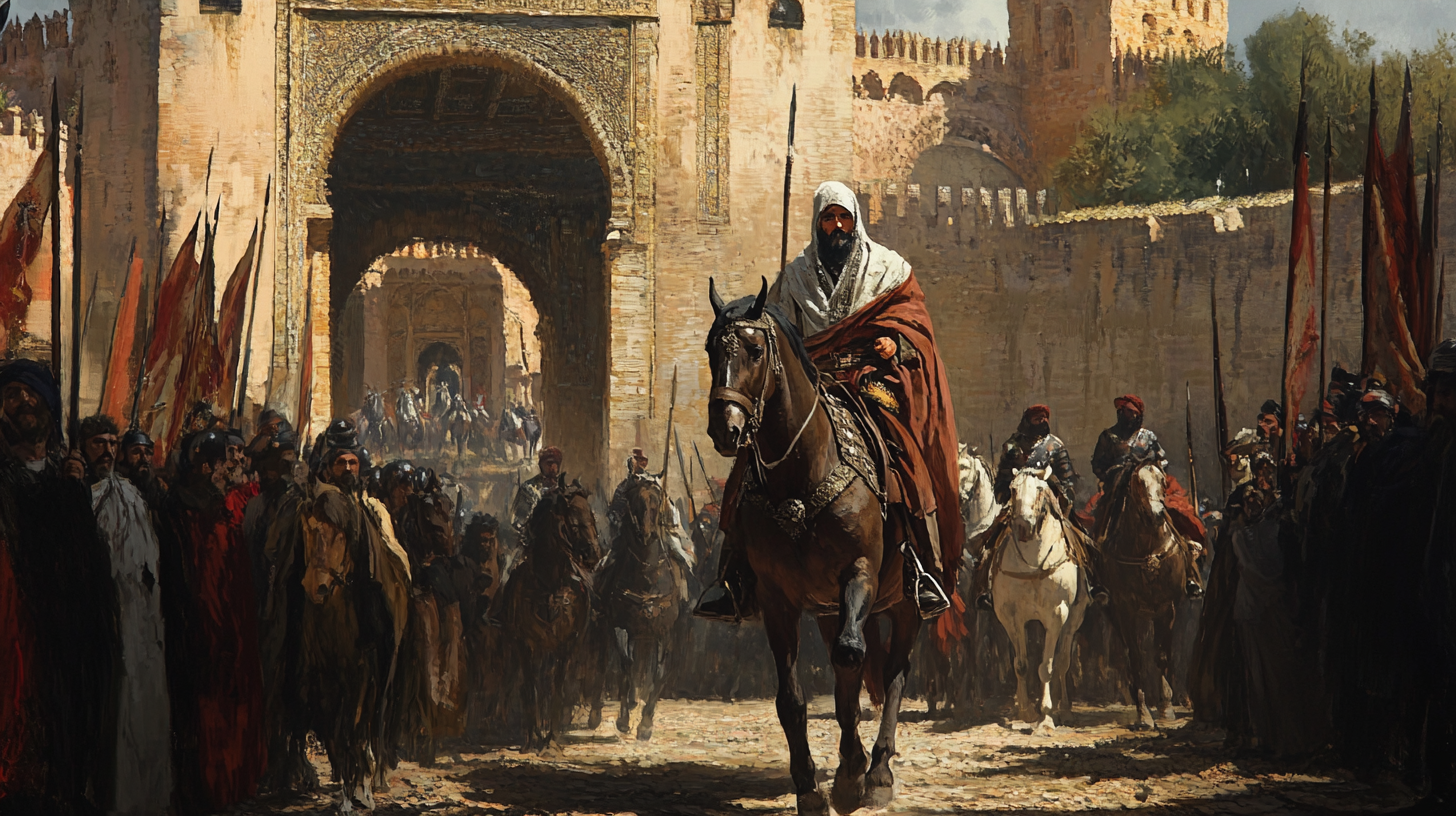
But his ambitions went beyond mere power consolidation. In 929, Abd al-Rahman declared himself Caliph of Córdoba, rejecting the nominal overlordship of the distant Abbasid Caliphate in Baghdad and countering the claims of the Fatimid Caliphate rising in North Africa. This declaration established al-Andalus as not just a province on the fringes of Islam but as a legitimate centre of power. It was a political move that granted al-Andalus a sense of prestige and purpose, setting it on a trajectory toward cultural and intellectual greatness.

The Golden City of Córdoba
Under Abd al-Rahman III, Córdoba blossomed into one of the preeminent cities of medieval Europe. It was not just a political capital but an intellectual and cultural one, boasting a population of roughly half a million, with paved streets and public lighting—features unheard of in most of Europe at the time. The city was a beacon of urban sophistication, with hundreds of public baths, libraries, and a bustling market filled with goods from across the known world.
It was in this vibrant atmosphere that Abd al-Rahman fostered the spirit of convivencia—a coexistence among Muslims, Christians, and Jews. The caliph understood the value of diverse expertise, and he sought the talents of all faiths. Jewish scholars like Hasdai ibn Shaprut held prominent positions at his court, while Christian artisans and engineers were integral to Córdoba’s physical transformation. This tolerance was not altruism; it was a calculated strategy to build a functioning society that could leverage the talents of all its subjects to reinforce his rule.
Power in Diversity
Abd al-Rahman III’s most enduring achievement may have been his ability to balance the various cultural and social forces within al-Andalus. He established a professional standing army, including mercenaries from Europe and Berber soldiers from North Africa, which gave him independence from local tribal forces whose loyalty was often questionable. He also minted gold dinars, an assertion of economic autonomy that helped tie the far reaches of al-Andalus together while anchoring the territory firmly in the broader Mediterranean trade network.
His economic policies were visionary for the time. He invested in agricultural projects, including improved irrigation techniques that allowed for the cultivation of new crops like rice, citrus, and sugar cane. This not only enriched the diet of his subjects but also fueled a vibrant economy that transformed al-Andalus into an agrarian powerhouse, supporting the opulent lifestyle of Córdoba’s elites and the intellectual pursuits that flourished in its universities and libraries.
Beyond agriculture, Abd al-Rahman III recognized the importance of industry and trade. Textile production, pottery, and metalwork thrived under his patronage, and Córdoba became a hub for luxury goods that were exported across Europe and the Islamic world. The bustling marketplaces were filled with merchants trading silk from China, spices from India, and gold from West Africa, making Córdoba not only a cultural but also an economic powerhouse. Trade routes crisscrossed the caliphate, linking it to distant regions and bringing wealth that supported both urban development and intellectual growth.
Cultural Flourishing and Intellectual Pursuits
Córdoba, under Abd al-Rahman III, became synonymous with learning and intellectual pursuit. The caliph was a patron of the arts and sciences, investing heavily in education and the collection of knowledge. The city was home to some of the largest libraries in the world, boasting hundreds of thousands of volumes. Scholars from different backgrounds flocked to Córdoba, attracted by the opportunities to engage in discussions and share knowledge.
The caliph’s court was a gathering place for some of the brightest minds of the age—philosophers, astronomers, poets, and physicians. This intellectual environment led to advances in various fields, including mathematics, astronomy, medicine, and philosophy. The translation movement, which had begun under earlier Umayyad rulers, reached new heights during Abd al-Rahman’s reign, with texts from Greek, Latin, and Persian being translated into Arabic and studied by scholars of all faiths. It was through this remarkable preservation and expansion of knowledge that many ancient works survived and eventually found their way to Western Europe, fueling the later Renaissance.
The Shadow of Decline
However, no ruler’s legacy is immune to the passage of time. Abd al-Rahman III’s son, Al-Hakam II, continued his father’s policies with some success, but the seeds of decline were sown during their reign. The reliance on a mercenary army, the tolerance that sometimes masked deep-seated tensions between religious communities, and the inability to integrate various tribal factions all contributed to the eventual fragmentation of al-Andalus.
The administrative structure that Abd al-Rahman had so meticulously constructed began to show cracks under the pressure of internal dissent and external threats. The rise of factionalism among the Berbers, Arabs, and local Andalusian converts led to instability that weakened central authority. By the early 11th century, the caliphate Abd al-Rahman III had painstakingly built began to disintegrate into the smaller taifas—petty kingdoms—each vying for dominance. These fragmented states were unable to mount a coordinated defense against the Christian kingdoms advancing from the north, who saw an opportunity to reclaim territories.
This political fracturing, along with the rise of Christian kingdoms to the north, heralded the slow decline of Muslim rule in Spain. Yet, the cultural and intellectual achievements of Abd al-Rahman’s reign left an indelible mark on Europe, influencing everything from architecture to philosophy and science. The Great Mosque of Córdoba, with its elegant arches and intricate mosaics, became an architectural marvel that inspired builders across Europe. The scientific texts and philosophical works produced in Córdoba found their way into monastic libraries and eventually became the foundation of European scholasticism.
Lessons from a Golden Age
The legacy of Abd al-Rahman III speaks to the power of ambition tempered with pragmatism. He was a ruler who understood that the sword alone could not hold an empire; it required legitimacy, culture, and a shared sense of identity. In a time when much of Europe languished in economic stagnation and feudal strife, Córdoba stood as a shining example of what was possible—a city where scholars debated ideas, architects pushed boundaries, and diverse communities found a way, however tenuous, to coexist.
Today, as Europe and the world grapple with questions of identity, immigration, and the clash of cultures, the story of Abd al-Rahman III offers both a warning and a source of inspiration. His reign was a testament to what can be achieved when a leader has the courage to build rather than simply conquer, to include rather than exclude. It was, in short, a golden age—fleeting, but one whose light still reaches us across the centuries.
The resilience of Abd al-Rahman III’s vision is evident in the enduring influence of al-Andalus. The integration of diverse cultures, the emphasis on learning and innovation, and the pursuit of prosperity through both military might and cultural investment demonstrate that even in a world rife with conflict, progress is possible. It is a reminder that the greatness of a civilization is often measured not by its ability to dominate, but by its capacity to inspire, include, and endure.